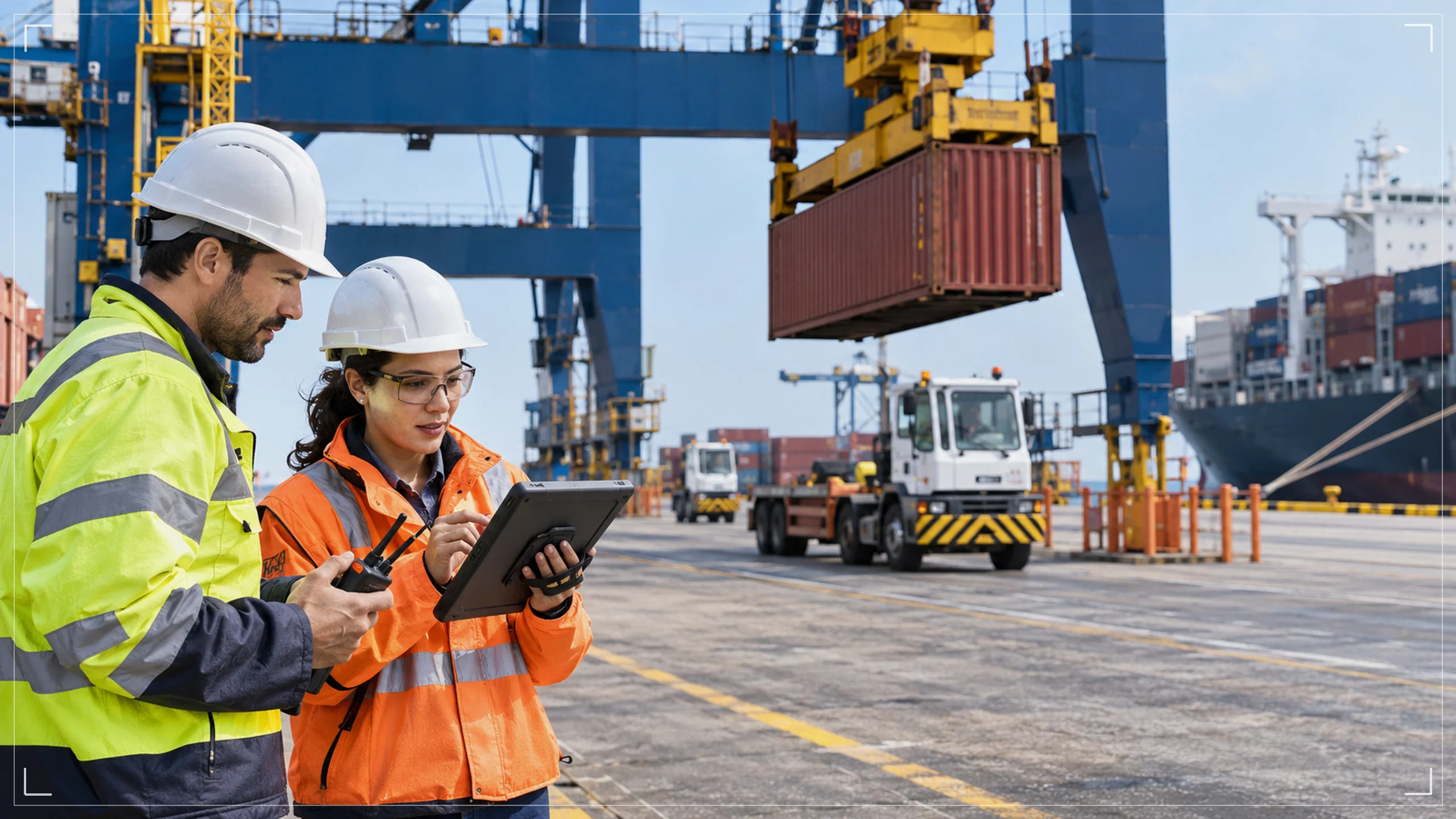
Quay crane motion control and container handling at a port terminal

Physical execution depends on the right control boundary

Physical action in a port or container terminal is carried out through equipment that moves, lifts, positions, or secures cargo. Examples include ship-to-shore (STS) cranes, rubber-tired gantry (RTG) cranes, rail-mounted gantry (RMG) cranes, reach stackers, terminal tractors, automated guided vehicles (AGVs), conveyor systems, and other cargo-handling equipment. Each asset has its own control architecture, operating envelope, and safety requirements.

Contact PortOps AI

Physical AI and Artificial Intelligence of Things (AIoT) can help connect operational observations and approved decisions to these physical workflows. The connection must be engineered carefully. An AI recommendation, a work-order request, a supervisory command, and a low-level motion-control signal are different things. A software workflow does not become equipment control simply because it creates a task or sends a message.

PortOps AI describes the technology considerations for connecting an authorized decision with a defined equipment response. Specific device compatibility, control interfaces, and deployment readiness must be established for each terminal and equipment type.

Control Technologies Used In Port and Terminal Equipment

Controllers and programmable logic

Programmable logic controllers (PLCs), industrial controllers, and equipment control units coordinate machine states and execute defined control logic. In a terminal, they may be part of crane hoist, trolley, gantry travel, spreader, conveyor, gate, or vehicle systems. The controller's role depends on the original equipment design and the control architecture approved by the equipment owner.

A supervisory application should exchange information through a documented interface rather than assume direct access to internal control logic. The interface needs to identify the equipment, requested operation, permitted operating mode, command status, and conditions under which the controller will reject or inhibit a request.

Drives, motors, brakes, and actuators

Variable-frequency drives, motor drives, servo systems, hydraulic power units, brakes, and actuators convert control outputs into physical movement. They are relevant to crane hoisting and travel, spreader positioning, conveyor movement, hatch-cover handling, and other material-handling tasks. Selection depends on the machine's load, duty cycle, motion profile, power supply, environmental conditions, and existing control design.

These components are not interchangeable. A command to move a trolley, for example, must be interpreted within the equipment's defined speed, travel, load, and interlock limits. Higher-level optimization should not replace the drive's validated motion-control functions or the machine's independent protective devices.

Robotic and autonomous equipment

Robotic and autonomous systems may support selected terminal workflows, including container-yard transport, automated stacking, inspection, and movement of materials between designated zones. Candidate platforms include AGVs, autonomous terminal tractors, robotic inspection systems, and remotely operated equipment. Their suitability depends on route definition, localization, obstacle detection, traffic rules, communications coverage, recovery procedures, and coordination with people and conventional vehicles.

A terminal may operate mixed fleets in which manually driven vehicles, remotely operated equipment, and autonomous systems share space. The control design must account for right-of-way rules, restricted areas, handover conditions, equipment availability, and the process for returning an asset to service after a fault or intervention.

Equipment Interfaces: Commands, Acknowledgments, and State

A physical-action interface needs more than a command field. It should define the equipment identifier, command type, target or operating parameter, permitted operating mode, authorization context, issue time, expiry or timeout behavior, and a unique command identifier. The receiving system should return a clear status, such as accepted, rejected, inhibited, executing, completed, or failed, where those states are supported by the equipment interface.

An acknowledgment confirms that a message or command was received or processed. It does not, by itself, prove that the intended physical movement occurred. The application should keep command acknowledgment separate from evidence about the resulting equipment state.

Timing is important in container handling. Commands can become invalid when equipment state changes, a work zone is occupied, a vessel or yard condition changes, or a communication delay makes the original observation stale. Interfaces should define timestamp handling, sequence rules, duplicate-command protection, timeout behavior, and how late or out-of-order messages are treated.

Supervisory Commands Must Remain Separate From Low-Level Control

Supervisory control operates at the level of an approved task or operating request. It may ask an equipment system to perform a bounded operation, subject to the machine's own control logic. Low-level control operates the motion and feedback loops that regulate motors, drives, brakes, hydraulic components, and other actuators. The two layers have different timing, validation, and safety responsibilities.

AI software should be treated as advisory unless a specific control pathway has been engineered, reviewed, tested, and authorized. A recommendation to reposition a container, for example, is not permission to move a crane. A supervisory command must pass the required authority checks and equipment-side conditions before execution. The equipment's validated control system remains responsible for its defined machine functions.

Independent protective functions must not depend solely on an AI model or a general-purpose application. Depending on the equipment and risk assessment, safeguards may include emergency stops, travel limits, overload protection, anti-collision functions, interlocks, access controls, and operator override. The actual protective architecture must be confirmed with the equipment manufacturer and site engineering team.

Authority, Interlocks, and Fault Handling In Terminal Environments

A control design should identify who or what may request, approve, execute, stop, and reset an action. Authority may belong to an equipment operator, a control-room supervisor, a terminal control system, or a designated automated function within a defined operating envelope. The role of each party should be explicit, including how control is transferred between local, remote, and automated modes.

Interlocks and operating conditions can prevent a command from proceeding when equipment is not in a permitted state. Relevant conditions may include a restricted travel zone, an occupied work area, an unavailable receiving vehicle, an unsecured spreader, an overload condition, a maintenance lockout, or a conflicting equipment movement. The application should report the reason for rejection or inhibition rather than repeatedly resubmit the same command.

Communications loss, power interruption, sensor disagreement, stale position data, and controller faults require defined responses. Depending on the equipment design, the safe response may be to stop accepting new supervisory requests, allow the local controller to complete a validated stop sequence, transfer to an approved manual mode, or require operator inspection before restart. Recovery behavior must be established and tested for the specific machine.

A Controlled Container-Transfer Workflow

Consider a conceptual container transfer from a vessel to a designated yard position. The example illustrates the separation between operational decision-making, equipment authorization, local control, and physical verification. It does not describe a deployed PortOps AI system or a universal crane-control sequence.

  1. Observe: receive the container identity, intended destination, equipment state, work-zone status, and relevant position or load information.

  2. Propose: generate a transfer recommendation or supervisory task using current operational constraints and terminal rules.

  3. Authorize: confirm that the responsible operator or approved control authority has accepted the task and that the equipment is in an eligible mode.

  4. Validate: check equipment-side interlocks, route or zone restrictions, load limits, and any other machine-specific permissives.

  5. Dispatch: send the approved supervisory request through the documented equipment interface. The local controller retains its validated motion logic.

  6. Acknowledge: record whether the command was accepted, rejected, inhibited, or timed out. Do not treat receipt as proof of completion.

  7. Verify: compare the requested destination and expected state with independent position, equipment, or operational evidence.

  8. Recover: record partial execution, failed movement, operator override, communication loss, and the approved recovery action.

This separation helps terminal teams distinguish an operational task from a physical command and a physical command from a verified result. It also creates a traceable record for investigating rejected actions, unexpected movements, and incomplete transfers.

Port terminal equipment authorization and physical outcome verification

Selecting and Evaluating Physical-Action Technologies

Technology selection should begin with the equipment and task, not with a preferred protocol or controller brand. Document the asset class, operating objective, existing control architecture, interface owner, authority model, operating modes, and protective functions before considering an integration.

  • Equipment scope: identify the crane, reach stacker, terminal tractor, conveyor, AGV, or other asset and the exact action being considered.

  • Control ownership: establish who owns the controller configuration, interface specification, operating limits, and change approval.

  • Interface definition: document command types, status codes, device states, timing requirements, identifiers, and error handling.

  • Operational constraints: include traffic patterns, work zones, load limits, environmental conditions, maintenance states, and shift procedures.

  • Safety and authority: define approval, interlocks, manual control, emergency response, override, and recovery responsibilities.

  • Connectivity and resilience: test network coverage, latency, message loss, buffering, reconnection, and behavior during outages.

  • Verification: specify the independent signals or operational records that can confirm the actual physical outcome.

Commissioning Evidence and Outcome Verification

A site-specific evaluation should begin with a bounded task and an agreed baseline. Test normal operation, rejected commands, stale inputs, duplicate requests, delayed acknowledgments, communication loss, partial execution, manual override, and recovery. Include operating conditions that are representative of the terminal's actual equipment, traffic, and work practices.

Commissioning evidence should show that the interface behaves as specified, authority checks are enforced, protective functions remain independent as designed, and operators understand the new workflow. Record the equipment configuration, software and controller versions, test conditions, observed faults, acceptance criteria, unresolved limitations, and approval responsibilities.

Outcome verification should compare the requested action with subsequent physical evidence. Depending on the task, this may include position or travel measurements, spreader or load state, vehicle location, sensor readings, equipment event logs, or a confirmed terminal operating record. If the evidence is unavailable or inconclusive, mark the outcome as unverified rather than completed.

A software demonstration can show that a proposed workflow or interface exchange functions under test conditions. It does not establish that a real installation is safe, certified, compatible with a particular crane or vehicle, or ready for production use. Those conclusions require equipment-specific engineering review, physical testing, and the appropriate site approvals.

Discuss A Port Equipment Control Workflow

PortOps AI can discuss the technology and integration questions involved in connecting operational decisions with port equipment. A useful first review identifies the target asset, the bounded action, the existing control interface, the responsible authority, and the evidence needed to verify the result.

Discuss your port equipment control requirements
Scroll to Top