

Cybersecurity, Physical Security, and Trusted Industrial AI Research for Port and Terminal Operations
Connected port and terminal operations depend on reliable observations, trusted equipment identities, and commands issued through controlled authority. Container handling, gate processing, yard vehicle movements, quay crane operations, vessel services, and terminal access systems increasingly exchange information across operational technology (OT), information technology (IT), and connected devices. Each connection creates a security consideration that must be assessed in the context of the physical work being performed.
Contact PortOps AIIntroduction
Research into cybersecurity and trusted industrial artificial intelligence (AI) examines how to protect the devices, networks, sensing systems, AI services, command paths, mobile platforms, and physical assets involved in these workflows. The objective is not simply to prevent unauthorized access. It is to understand whether an observation can be trusted, whether a decision has valid authority, whether an action remains within its approved operating boundary, and whether the terminal can recover safely when a component or connection is compromised.
This research direction supports Physical AI and the Artificial Intelligence of Things (AIoT) across identification, sensing, decision support, and authorized physical action. Security controls must be considered alongside equipment safety, operational continuity, workforce privacy, and the practical requirements of port operations.
Why Cybersecurity is Different In Port and Terminal Operations
A port is a distributed operating environment. Terminal operating systems, gate and access-control equipment, container identification points, radio and wireless networks, cameras, environmental sensors, vehicle systems, crane interfaces, and remote maintenance connections may serve different owners and operational teams. Some systems support business coordination, while others provide information used near equipment and physical movement. Their security requirements cannot be treated as interchangeable.
A compromised identity reader could associate a container or chassis with the wrong event. A manipulated camera or sensor feed could misrepresent a restricted-area condition or the position of a mobile asset. An unauthorized command path could create risk if it reaches equipment responsible for lifting, transferring, or moving cargo. A disruption to authentication or network services could also delay gate transactions, yard coordination, or maintenance work.
Research therefore needs to define the system boundary before testing a control. The boundary should identify the equipment class, connected devices, responsible operator, data sources, interfaces, remote access routes, operational dependencies, and the physical consequence of an incorrect or unavailable output.
Device Identity, Onboarding, and Lifecycle Security
Connected readers, cameras, sensors, gateways, edge computers, vehicle systems, and control interfaces need a defined identity and an accountable lifecycle. Research questions include how a device is authenticated before it joins a terminal network, how its approved role is recorded, how credentials are rotated, and how access is revoked when equipment is replaced, transferred, lost, or retired.
Candidate methods include device certificates or other managed credentials, inventory reconciliation, controlled enrollment, least-privilege service identities, and lifecycle records linked to asset ownership. Network segmentation can limit the routes available to devices that serve different purposes. Remote maintenance should use restricted access paths, explicit approval, time-bounded permissions, and records of the session and changes made.
A proposed demonstration can use simulated container identification readers, yard sensors, and a command gateway in an isolated test environment. Test valid onboarding, duplicate identities, expired credentials, an unrecognized device, and attempted access from an unauthorized network segment. Compare the candidate controls with a documented baseline configuration.
Evaluation should measure unauthorized enrollment success, time to detect and isolate an invalid device, false rejection of legitimate devices, and the effect on normal event delivery. Results should be reported by device class and scenario. A testbed result does not establish compatibility with every terminal device or prove that a production network is secure.
Protecting Sensor Integrity and AI Decision Inputs
Operational decisions are only as dependable as the observations used to support them. Port environments include moving vehicles, reflective and occluded surfaces, changing light, weather exposure, radio interference, and high equipment density. Research should examine how sensor faults, deliberate spoofing, incorrect asset associations, stale timestamps, and conflicting observations affect the state presented to an operator or AI service.
Candidate methods include authenticated device-to-gateway communication, integrity checks on event records, plausibility rules across independent observations, time synchronization monitoring, sensor health indicators, and explicit handling of uncertainty. For example, a container movement event may need to be checked against a reader observation, a vehicle or equipment identifier, a timestamp, and a known terminal zone before it is treated as a confirmed transfer.
The research question is not whether one sensor can be made infallible. It is whether the system can recognize degraded or inconsistent evidence, avoid treating uncertain observations as confirmed facts, and route exceptions to an appropriate human reviewer. AI agents and decision services also require controls over the data, tools, and commands they can access. Their permissions should be limited to the task, and high-impact actions should require the defined authorization path.
A demonstration can introduce manipulated location or identity observations into an isolated event pipeline and compare the resulting state estimate with a protected reference record. Evaluation can include spoofed-event acceptance, detection delay, false alarms, unresolved exceptions, and degradation of legitimate terminal tasks.
Secure AI, Software, Data, and Model Supply Chains
Industrial AI components may depend on software libraries, model files, training data, configuration packages, edge applications, and remote update services. Research should examine how these components are identified, reviewed, delivered, installed, and rolled back. The goal is to make unauthorized or altered components detectable and to preserve traceability from an approved release to the version running at a site.
Candidate methods include signed software and model packages, controlled build and release processes, dependency inventories, version pinning, integrity verification, access separation between development and operations, and recorded approvals for production changes. Data lineage should identify where training and evaluation data came from, which transformations were applied, and which version was used for a given model evaluation.
Research questions include whether an edge device can reject an altered package, whether a model update can be traced to an approved source, how a failed update is reversed, and how operators can identify the active software and model versions during an incident. Any test should use authorized test assets and non-production credentials. No unapproved update should be introduced into live terminal equipment.
Physical Access, Perimeter, and Asset Protection
Cybersecurity does not replace physical security. Terminal gates, equipment compounds, server and network rooms, control cabinets, camera poles, maintenance areas, and restricted operational zones have physical access requirements. Research can examine how access events, surveillance observations, equipment identity, and operational records are correlated to support security review without treating a single sensor as definitive evidence.
Relevant research questions include how to detect an access event that conflicts with an approved work order, how to preserve camera and access-control records for investigation, and how to identify tampering or unauthorized connection to a field cabinet. Candidate methods may include tamper indicators, controlled cabinet access, segmented device connections, time-aligned event correlation, and documented inspection workflows.
Workforce sensing and analytics require separate privacy analysis. A research design should state the operational purpose, what information is collected, who can access it, how long it is retained, and whether individual-level tracking is necessary. Personnel location data should not be collected merely because a technology makes it possible. Access and retention rules need review by the relevant operational, privacy, legal, and workforce stakeholders.
Incident Containment, Recovery, and Verified Restart
A security incident in a terminal can affect more than information confidentiality. It may interrupt container identification, gate processing, equipment visibility, remote support, or a command path used by a physical system. Research should therefore examine containment and recovery as operational workflows, not just as IT restoration tasks.
Candidate methods include isolating a compromised device or fleet member, revoking credentials, restricting affected network paths, preserving event and command logs, switching to an approved degraded operating procedure, and restoring components from known-good configurations. Recovery planning should identify which functions may continue, which must stop, who can authorize a restart, and what evidence is required before normal operation resumes.
A proposed demonstration can simulate a compromised gateway or mobile-platform member in an isolated testbed. The test can introduce invalid credentials, manipulated observations, an untrusted update, or loss of communication. The response should record detection, containment, operator escalation, restoration, and independent checks of the physical or operational state before restart.
Evaluation measures should include detection delay, containment time, recovery time, false alarms, legitimate-task degradation, residual unauthorized-action success, and the completeness of physical outcome checks. A successful restart should not be inferred solely from a device reconnecting or a command being acknowledged. The relevant equipment state and operational conditions need independent confirmation.
Mobile-platform Perception, Localization, and Teleoperation Security
Autonomous or remotely operated mobile platforms may be considered for inspection, patrol, or other bounded tasks in port environments. Their security depends on more than the vehicle connection. Perception inputs, localization references, shared maps, fleet membership, remote operator identity, software updates, and command channels can all influence platform behavior.
Research questions include how a platform detects inconsistent localization data, how a compromised fleet member is isolated, how shared-map changes are authenticated, and how a teleoperation session is authorized and terminated. Candidate methods include authenticated fleet membership, integrity-protected map distribution, command authorization, update verification, communication-loss behavior, and a safe transition to a predefined stopped or supervised state.
Testing should use a controlled, isolated environment with simulated or approved test platforms. Scenarios may include manipulated landmarks, stale map data, invalid operator credentials, interrupted communications, and an altered update package. The test must not interfere with live vehicle traffic, cargo handling, or safety systems.
Cryptographic Agility and Post-quantum Migration
Long-lived industrial equipment and connected infrastructure may remain in service across multiple technology and cryptographic transitions. Research can examine how cryptographic algorithms and credentials are inventoried, how protocol changes affect constrained devices and gateways, and how an organization can replace cryptographic components without losing device identity or operational continuity.
A proposed evaluation should compare candidate cryptographic configurations using the same representative device and message workloads. Measure authentication and handshake time, message-processing overhead, memory and compute use, network bandwidth, update size, and effects on event delivery or command latency. Post-quantum options should be treated as candidates for controlled evaluation, not as a blanket requirement or an established fit for every device.
Migration planning should account for equipment lifecycle, supplier support, certificate and key management, protocol dependencies, fallback behavior, and the ability to update devices that have limited compute or maintenance access.
Research Demonstration and Evaluation Approach
The initial demonstration should be an authorized, isolated testbed representing selected port workflows. It may combine simulated device identities, sensor and event feeds, a network gateway, an AI decision service, a command gateway, and a simulated or approved mobile platform. The testbed should not connect to live terminal control networks or production equipment.
The test plan should define the operational question, asset and device classes, baseline configuration, candidate controls, data sources, test scenarios, responsible reviewers, and stop conditions before execution. Scenarios should include normal operation as well as invalid authority, manipulated observations, compromised updates, device loss, communications failure, and recovery.
The evaluation should report, at minimum:
Residual unauthorized-action success: the proportion of attempted unauthorized actions that still reach the defined execution point.
Detection delay: elapsed time between the start of a defined security event and its detection.
False alarms: security alerts raised when the defined test condition is not present, with the denominator and test window stated.
Legitimate-task degradation: the effect of security controls on valid event processing, gate or yard workflows, or approved equipment tasks.
Containment and recovery time: elapsed time to isolate the affected component and restore the approved operating state.
Physical outcome checks: whether the observed equipment or platform state matches the expected safe and authorized result.
Cryptographic resource cost: compute, memory, bandwidth, latency, and update overhead for the configurations tested.
Results should be separated by scenario and device class. The baseline, test configuration, number of runs, data provenance, and limitations should be documented. If a test is not executed, describe it as a proposed method and do not report numerical findings.
Limitations and Evidence Boundaries
Research evidence is not a cybersecurity certification, a physical security assessment, or proof that equipment is safe for autonomous operation. A controlled testbed can show how specified controls behaved under specified conditions. It cannot establish performance across every terminal layout, supplier configuration, network topology, weather condition, operating shift, or threat scenario.
Synthetic data can support repeatable tests, but it may not reproduce the full complexity of field observations. Synthetic data derived from private operational records still requires a disclosure-risk review before release. Real deployments require site-specific architecture review, authorized testing, equipment-owner approval, operational involvement, and validation against applicable safety and security requirements.
Cybersecurity controls, physical security measures, workforce privacy, and equipment safety must be evaluated as related but distinct disciplines. A security control should not be described as a safety function unless that role has been separately engineered and validated. Proposed controls should be clearly distinguished from controls that have been implemented and tested.
Current Research Status
The topics on this page define a research agenda and candidate demonstration methods. This page does not report a completed PortOps AI cybersecurity test, a customer deployment, a certified security control, or measured performance results. Any future findings should identify the tested environment, control versions, scenarios, metrics, limitations, reviewer, and approval date.
The broader Physical AI research initiative is shared work associated with Aperture Venture Studio, GAO RFID Inc., and GAO Tek Inc. That shared initiative should not be interpreted as evidence of a separate research team, completed capability, or customer deployment at every portfolio company. PortOps AI-specific activity and results should be identified separately when verified.
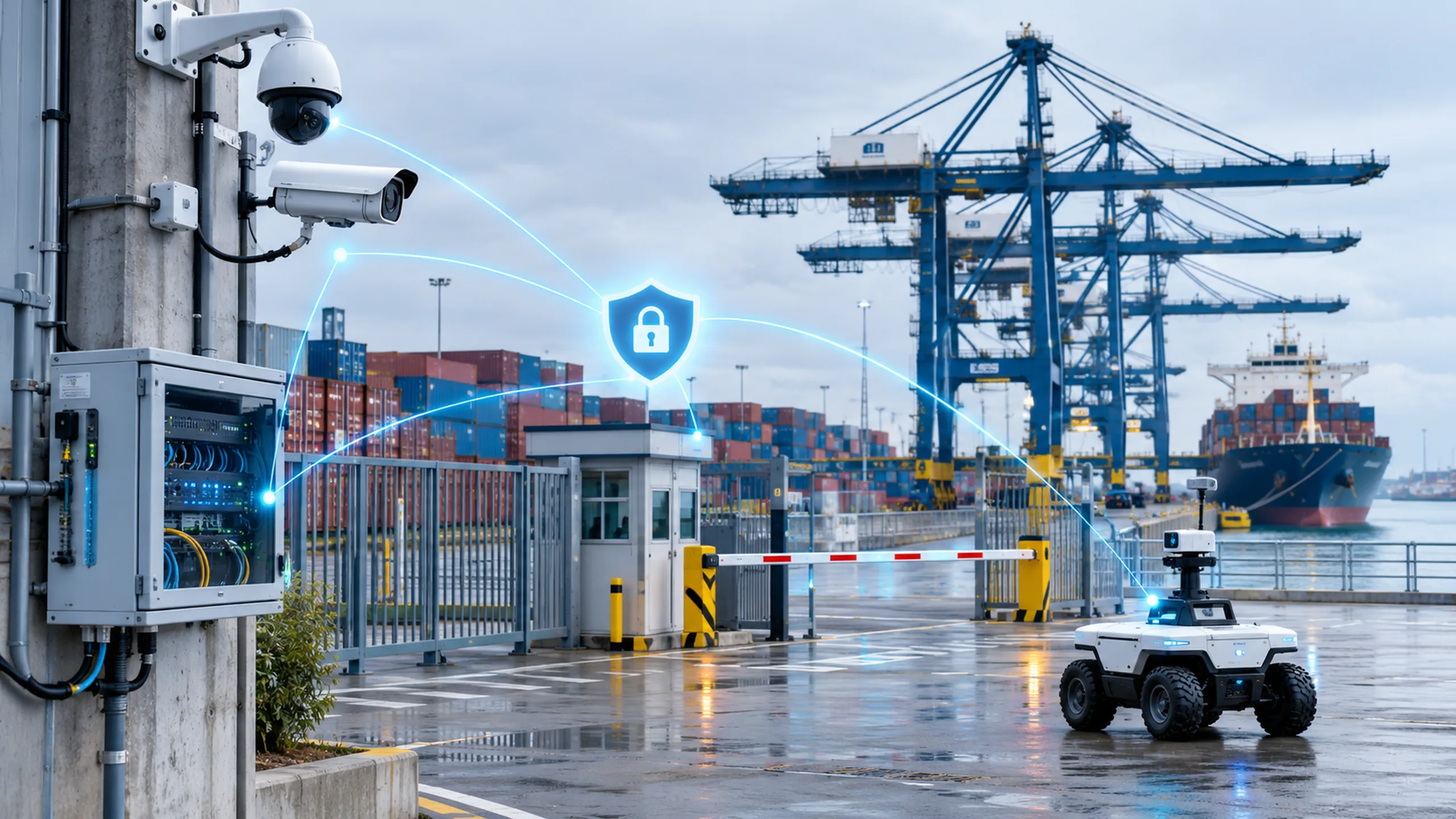
Privacy, Operational Oversight, and Trusted Security Monitoring
Security monitoring can bring together access-control events, camera observations, device health, network alerts, and operational records. The value of correlation depends on reliable timestamps, known data sources, defined access rights, and a review process that distinguishes an alert from a confirmed incident. Operators should be able to see why an event was escalated and which evidence supports the assessment.
Research should also examine how monitoring affects workers. Camera analytics, location records, and workforce-related event data should be limited to a documented operational purpose. Data collection, access, retention, and review responsibilities should be defined before a demonstration begins. Where individual identification is not required, the design should consider whether aggregated or de-identified information can answer the operational question.
A useful evaluation compares security coverage with operational burden. Measures can include alert review time, false-alert rate, missed test events, data completeness, access-log traceability, and interruption to normal work. The evaluation should also document whether operators understand the alert, can challenge an incorrect association, and know who has authority to initiate containment or recovery.
How This Research Connects To Physical AI and AIoT
Security is a cross-cutting requirement rather than a separate engine. Identification depends on trusted device and asset identity. Sensing depends on observation integrity and data quality. AI decision services depend on protected data, controlled model versions, and bounded permissions. Physical action depends on authenticated commands, explicit authority, operating limits, and independent confirmation of the resulting state.
For port and terminal workflows, this means that a security review should follow the full chain from a field observation to the operational record, decision, command request, and observed outcome. A weakness at any point can affect the reliability of the overall workflow. The research focus is to make those dependencies visible and testable.
Discuss A Port Security Research Question
Port operators, terminal engineering teams, OT and IT security professionals, and system integrators can use this research agenda to define a bounded evaluation. A useful starting discussion identifies the asset or workflow at risk, the systems and suppliers involved, the available test data, the operational baseline, and the evidence needed to judge the result.
For a technical discussion, contact PortOps AI