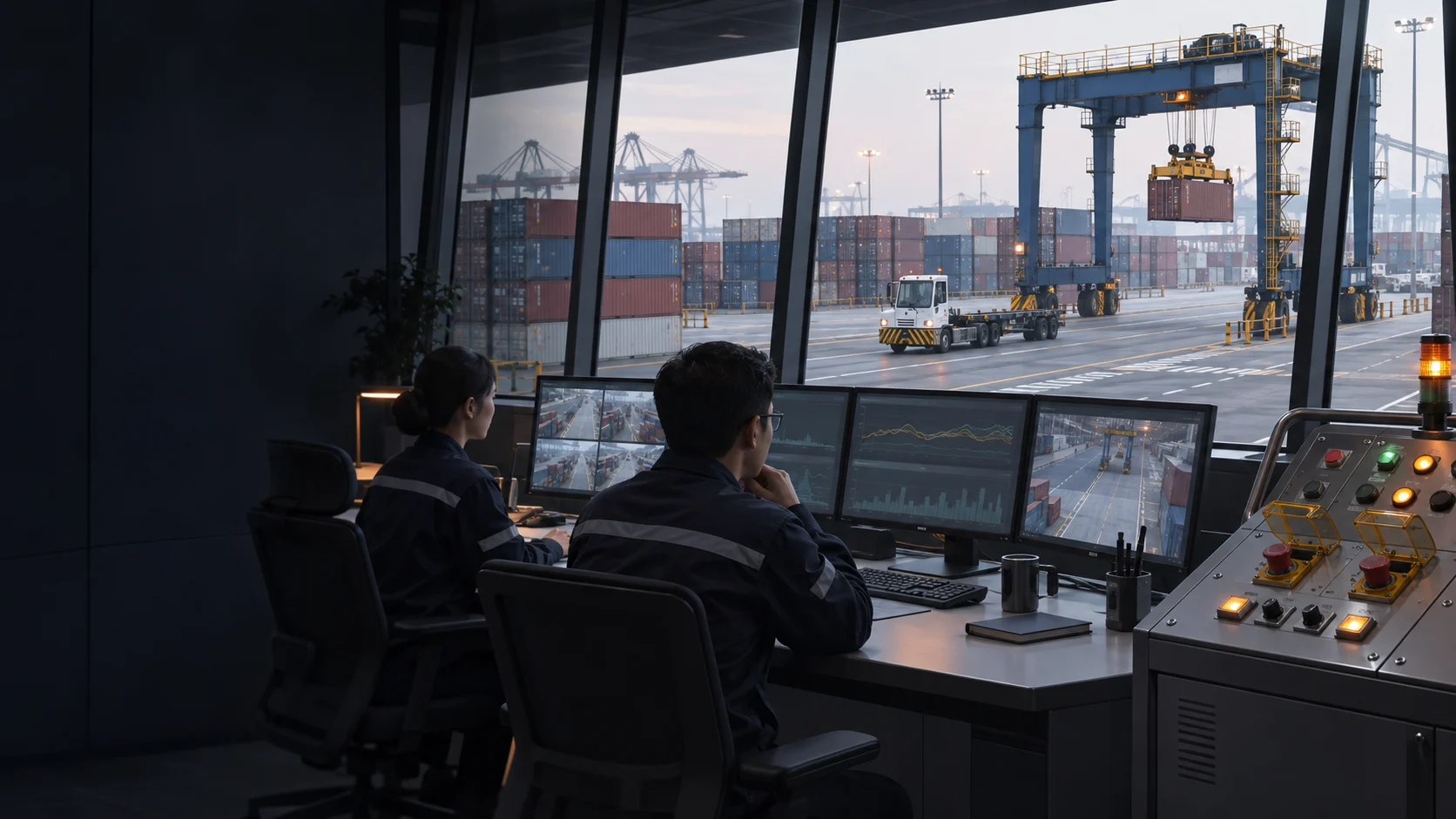
Port terminal control room at dawn

A layered architecture for port and terminal operations

Port and terminal operations depend on accurate information about containers, cargo, yard equipment, vessel activity, and the movement of assets across busy operating areas. That information is useful only when it can be associated with the right asset, interpreted in its operating context, and connected to a decision that the responsible team can review and act on.

Contact PortOps AI

PortOps AI’s architecture separates the connected intelligence functions from the physical execution path. The PortOps AI AIoT Engine™ brings together identification, sensing, and AI-supported decision functions. The larger PortOps AI Physical AI Engine™ includes that AIoT configuration and adds a Physical AI Action Engine for authorized commands, equipment interfaces, and verification of the resulting physical state.

This separation matters in a terminal. Detecting a container at a location, identifying an abnormal equipment condition, or recommending a response does not itself move equipment or change a process. Physical execution requires a defined target, an approved command path, operating limits, suitable control interfaces, and evidence that the intended result occurred.

Two Related Configurations, With Different Responsibilities

PortOps AI AIoT Engine™: identify, sense, and decide

The AIoT Engine™ organizes the information path from the terminal environment to an operational decision. Its three engines have distinct responsibilities:

  • Identification Engine: associates observations and events with the correct container, chassis, yard tractor, reach stacker, crane, cargo unit, or other selected asset. Depending on the workflow, identification inputs may include RFID reads, Bluetooth Low Energy (BLE) signals, ultra-wideband (UWB) location observations, barcode or optical reads, and camera-based observations. Technology selection depends on the site layout, read zones, mounting conditions, interference, visibility, and required location granularity.

  • Sensing Engine: captures physical and operating conditions relevant to the identified asset or process. Potential inputs include equipment vibration, temperature, electrical measurements, hydraulic pressure, position, operating status, and environmental measurements. Readings need units, timestamps, sampling context, calibration information, and quality flags before they can support a reliable interpretation.

  • AI Decision Engine: evaluates identity records, sensor observations, historical information, terminal operating rules, and current constraints. Depending on available evidence and evaluation, it may support anomaly detection, risk prioritization, prediction, exception classification, or operational recommendations. Outputs should include the relevant decision context, uncertainty, and a clear indication of whether human review is required.

PortOps AI Physical AI Engine™: add authorized physical execution

The Physical AI Engine™ contains the AIoT Engine™ and extends the architecture with a separate Physical AI Action Engine. The action engine receives a decision output, checks whether the requested action is permitted under the configured authority and operating constraints, and passes an eligible command to an appropriate equipment or control interface.

In a port or terminal, a potential action path could involve a terminal operating workflow, equipment gateway, programmable logic controller (PLC), drive, actuator, or robotic interface. The actual interface depends on the equipment, control system, site engineering, safety design, and integration approval. A recommendation, work-order request, or dispatch instruction must not be described as direct machine control unless a validated control interface is in place.

The action engine should distinguish human-mediated execution, human-approved commands, and bounded autonomous operation. Permissions, interlocks, independent protective functions, manual override, command timeouts, communications-loss behavior, and recovery procedures must be defined for the specific installation.

How Information Moves Through The Architecture

The architecture uses separate observation, decision, and command paths. Keeping these paths distinct makes it easier to trace how a physical observation became a recommendation, who authorized an action, which interface received the command, and what evidence confirmed the outcome.

  1. 1. Identify the asset and its movement context

    An observation point records an identifier or location event for a container, chassis, yard vehicle, crane, or cargo unit. The identification function associates the event with an asset record and a terminal zone, such as a gate lane, container yard block, transfer point, quay area, or equipment operating zone. Missed reads, duplicate events, stale observations, and conflicting associations should be flagged rather than silently treated as confirmed movement.

  2. 2. Capture operating and equipment conditions

    Sensors and connected equipment provide measurements or state changes. Each record should retain the asset association, event time, ingestion time, measurement value, unit, source, and quality status. For example, a crane or yard vehicle condition record may include a temperature or vibration measurement together with the equipment operating mode. The architecture must distinguish a measured value from an inferred condition.

  3. 3. Evaluate the current state and produce a decision output

    The AI Decision Engine evaluates the observations alongside relevant terminal rules and operational context. A decision may identify an exception for review, prioritize an equipment inspection, or propose a constrained operational response. If the observations are stale, incomplete, conflicting, outside evaluated conditions, or below a defined confidence threshold, the system should abstain, request more information, or escalate to an authorized operator.

  4. 4. Authorize and dispatch an eligible command

    Where physical action is within scope, the Physical AI Action Engine checks the target, requested operation, user or system authority, operating limits, and required interlocks. An approved command is routed through the configured gateway, controller, or equipment interface. The command record should retain its authorization outcome, dispatch status, acknowledgment, timeout state, and any rejection or override.

  5. 5. Verify the physical result

    A command acknowledgment confirms that an interface received or accepted a command; it does not prove that the intended physical change occurred. Verification requires subsequent evidence from an independent or otherwise suitable observation, such as a position update, equipment state, sensor measurement, confirmed transfer event, or operator inspection record. The observed outcome is linked back to the originating decision and command so that the operational record can be reviewed.

System Boundaries and Integration Points

A practical implementation may span field devices, edge processing, server or cloud services, operational users, and external business or control systems. The architecture describes functional responsibilities; it does not imply that every deployment uses every layer or that a particular connector, protocol, device, or hosting model is already supported.

Field devices and terminal equipment

Field inputs may include identification tags and readers, cameras, positioning devices, condition sensors, equipment telemetry, gateways, and controller interfaces. Selection and placement must account for container stacks, metal structures, weather exposure, vibration, dust, electromagnetic conditions, line of sight, power availability, maintenance access, and network coverage. Equipment-specific requirements must be confirmed during site assessment.

Edge processing and communications

Edge devices or gateways may collect observations, normalize device messages, associate events with assets, buffer data during connectivity interruptions, and perform time-sensitive processing where required. The design should define timestamp sources, clock synchronization, local storage limits, retry behavior, duplicate handling, and how buffered events are reconciled after a network outage.

Server, cloud, and enterprise systems

Server or cloud services may support data storage, analytics, model execution, dashboards, audit records, and integration services, depending on deployment requirements. Relevant enterprise interfaces may include a terminal operating system (TOS), enterprise resource planning (ERP), computerized maintenance management system (CMMS), warehouse management system (WMS), supervisory control and data acquisition (SCADA), or other site-specific systems. Each proposed interface needs an agreed data contract, ownership, access rules, and integration testing.

Operational users and authority

Terminal operators, equipment operators, maintenance personnel, control-room staff, engineering teams, and IT/OT administrators may interact with different parts of the system. Role-based access should define who can view observations, review alerts, approve a command, change operating rules, or administer interfaces. Personnel-location information, where used, requires a defined purpose and appropriate access, retention, and privacy controls.

Cross-cutting Controls For Dependable Operation

  • Identity and data quality: validate asset identifiers, units, event ordering, timestamps, sensor health, and source provenance. Preserve uncertainty and quality flags when observations are incomplete or conflicting.

  • Access and authorization: apply role-based permissions, least-privilege access, authenticated interfaces, and explicit approval rules for commands. Separate administrative access from operational command authority.

  • Timing and traceability: record event time and ingestion time separately. Link observation, decision, authorization, command, acknowledgment, and observed outcome records with traceable identifiers.

  • Logging and audit: retain model or ruleset version, decision rationale or relevant inputs, user approvals, command status, overrides, and verification evidence according to the site's retention policy.

  • Connectivity loss and recovery: define local behavior, buffering, stale-data handling, retries, duplicate suppression, timeout handling, and safe recovery after communications return.

  • Human oversight and protective functions: provide operator review and override where required. AI decision logic must not replace independent equipment protections or site safety procedures.

  • Model and configuration control: document model versions, decision thresholds, configuration changes, evaluation conditions, drift monitoring, rollback responsibility, and review ownership.

Evaluation and Deployment Considerations

Architecture review should begin with a specific terminal workflow and a defined operating boundary. Identify the asset classes, observation points, users, data sources, enterprise systems, command interfaces, operating constraints, and responsible technical owners. Confirm which components are existing, proposed, demonstrated, or still untested.

For identification and traceability, useful evaluation measures may include required-event completeness, false associations, duplicate-event rate, unresolved transfers, reconciliation time, and user effort. For sensing and condition assessment, consider missing-data handling, calibration requirements, detection delay, false-alert rate, and review workload. For decision and action workflows, evaluate decision quality, rejected commands, constraint violations, human interventions, timeout recovery, and independently verified outcomes.

Use a credible baseline and representative operating conditions. Include routine operations and degraded conditions such as missed reads, sensor drift, delayed messages, network outages, stale observations, incorrect asset associations, denied commands, and failed or partial execution. Report adverse outcomes as well as improvements. A simulation or software demonstration does not establish field performance, safe deployment, or equipment certification.

Discuss An Architecture For Your Terminal Workflow

The right architecture depends on the terminal's equipment, operating processes, existing systems, data quality, control boundaries, and required evidence. Discuss a specific workflow with PortOps AI to define the assets and observations involved, identify integration dependencies, and determine how decisions, approvals, physical execution, and outcome verification should be evaluated.

Discuss your port or terminal application
Scroll to Top