
Asset Movement and Handover in Port Terminals
A container can pass through several equipment operators and operating zones between vessel discharge and its assigned yard position. Each transfer creates a point where the physical movement must be matched with the correct container identity, movement instruction, and operational record. When a handover is missed or recorded against the wrong unit, terminal teams may need to reconcile equipment activity, yard inventory, and work instructions before the next move can proceed.
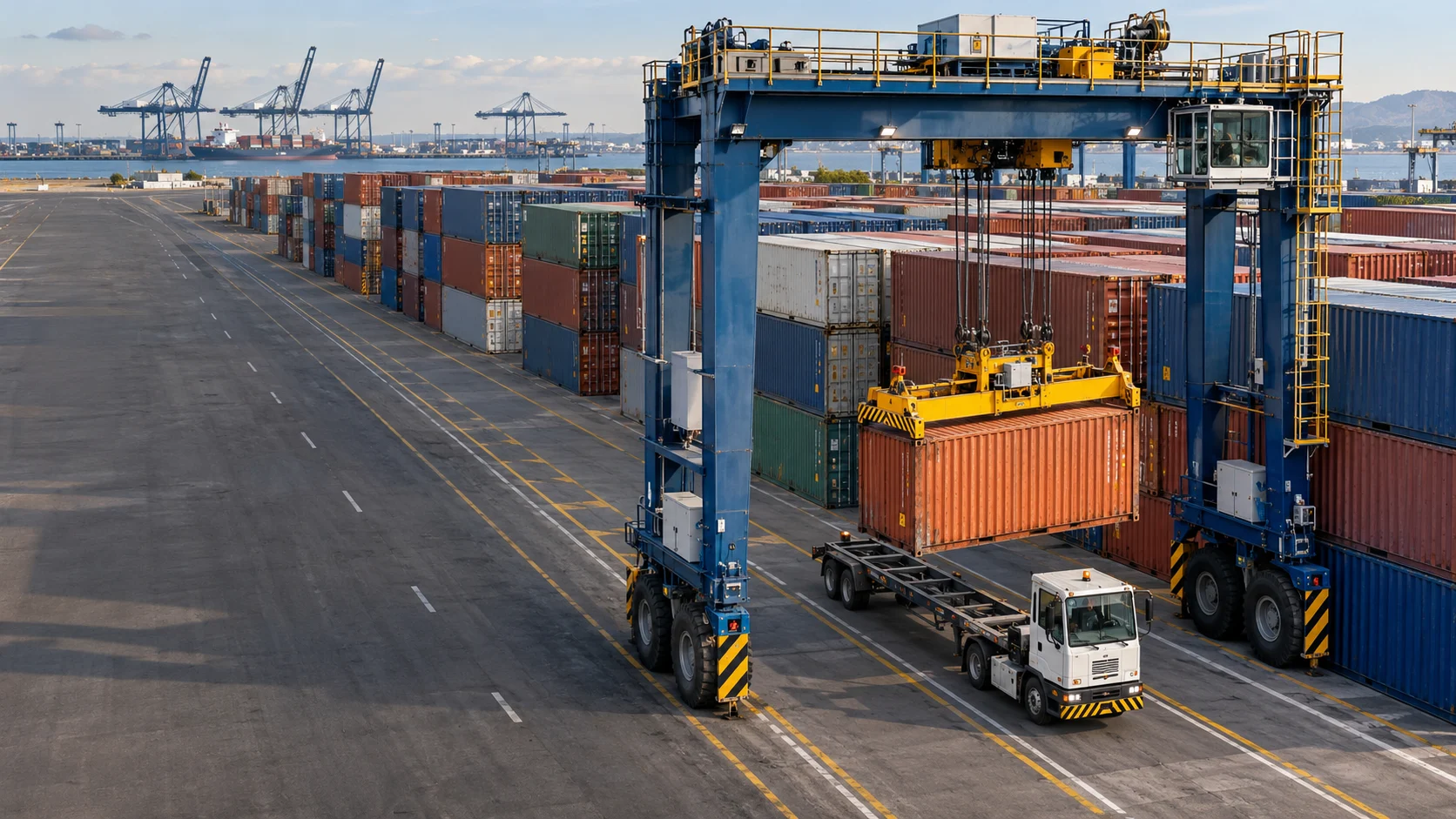
PortOps AI examines how Physical AI and Artificial Intelligence of Things (AIoT) can support container movement visibility and handover traceability across quay and yard operations. The application described here follows a defined workflow: a container is discharged from a vessel by a quay crane, transferred to a terminal tractor, transported to a yard block, and received by a rubber-tired gantry (RTG) or rail-mounted gantry (RMG) crane. The exact equipment sequence varies by terminal layout and operating procedure.
Contact PortOps AIWhere container handovers occur
The handover chain begins when a container is identified against the vessel discharge or terminal move instruction. At the quay, the quay crane places the container onto a terminal tractor or other designated transfer vehicle. The tractor driver accepts the move and transports the unit along the terminal’s approved traffic route. At the assigned yard block, the receiving yard crane lifts the container from the vehicle and places it in the designated stack position. The movement record should distinguish the planned destination from the position actually confirmed by the receiving operation.
These events involve different roles and equipment: quay crane operators, terminal tractor drivers, yard crane operators, dispatchers, yard planners, and control-room or terminal operations personnel. A useful traceability record links the container identifier, move or job reference, event time, observation time, source zone, destination zone, equipment or reader source, and handover status. Personnel location data is not required to establish container traceability and should be treated as a separate, purpose-specific workflow.
A movement record from quay to yard
A practical event sequence can be organized around five checkpoints:
- Arrival and move assignment: associate the container number with the vessel discharge plan, terminal move instruction, and intended yard block.
- Quay identification and release: capture the container identity at the discharge or transfer point and associate it with the equipment move.
- Terminal tractor handover: record the transfer to the assigned tractor or move task, including the time and origin zone.
- Yard arrival and receipt: capture the arrival at the intended yard block and confirm that the receiving crane operation corresponds to the same container and move.
- Record reconciliation: compare planned and observed events, resolve discrepancies, and close the movement only when the required receipt evidence is available.
The event chain should preserve both event time and observation time. Event time represents when the operational transfer occurred; observation time represents when a reader, device, or user record was received by the application. Keeping both values helps identify delayed messages and out-of-order records without silently changing the sequence of physical events.
Identification, sensing, and event association
Identification design should begin with the required operational event, not with a predetermined device. Radio-frequency identification (RFID) may support identity reads at controlled checkpoints when tags, readers, mounting, and read zones are suitable. Bluetooth Low Energy (BLE) or ultra-wideband (UWB) may be considered where the requirement involves locating tagged equipment or assets within defined areas. Cameras and computer vision may provide another observation source where container markings, camera position, lighting, weather, and occlusion allow reliable image capture. These technologies serve different purposes; none should be assumed to provide universal coverage or accuracy.
A terminal may combine equipment-generated move events, fixed identification points, handheld scans, camera observations, and operator confirmations. Each observation should be associated with a source, timestamp, container identifier, location or zone, event type, and quality status. Where the terminal operating system (TOS) provides a move instruction or equipment transaction, the integration should define how the observed event is matched to that record. The interface and data fields must be confirmed with the terminal’s actual systems.
Exceptions that require operational review
Movement visibility is useful only when uncertain or conflicting observations are handled explicitly. Common exceptions include:
- Missed observation: a container passes a checkpoint but no usable read or event is received.
- Duplicate event: the same movement is recorded more than once because of repeated reads, retries, or message replay.
- Incorrect association: an observation is linked to the wrong container, tractor, move instruction, or yard location.
- Delayed or out-of-order event: a message arrives after a later physical event has already been recorded.
- Unconfirmed receipt: the destination arrival is observed, but the required yard placement or receiving transaction is not confirmed.
- Conflicting records: equipment activity, operator confirmation, and terminal inventory records do not agree.
The system should flag these cases for review rather than infer a completed handover from a single weak observation. An authorized user can compare the move instruction, equipment transaction, available identification evidence, and destination record. The correction should retain the original event, the reason for the change, the user or process responsible, and the resolution time. This creates an auditable history instead of overwriting the discrepancy.
From observations to a reconciled handover
An AIoT workflow can collect identification and equipment events, normalize timestamps, filter duplicate messages, and associate observations with container and move records. Physical AI functions may add decision support by identifying incomplete handover chains, highlighting conflicting location evidence, or prioritizing records that need operator attention. The appropriate response may be a notification, a review task, or a request to verify the destination transaction. Tracking and traceability do not, by themselves, authorize or execute physical equipment movement.
A reliable handover state should be based on the evidence required by the terminal’s operating procedure. For example, a vehicle arrival observation can indicate that a container reached a yard zone, but it does not necessarily prove that the yard crane placed the unit in the assigned stack position. Where the process requires confirmed receipt, the record should include a receiving transaction, operator confirmation, or another independently reviewed source appropriate to the site.
Integration with terminal operating records
The movement workflow may need to exchange data with a terminal operating system, equipment management applications, yard planning tools, gate records, or other operational systems. The integration design should identify the system of record for container identity, move assignment, equipment transaction, and final yard position. It should also define identifier formats, event codes, time zones, timestamp precision, message ordering, duplicate handling, rejected records, and recovery after connectivity interruptions.
Before implementation, confirm whether the relevant systems expose an application programming interface (API), message interface, database view, file exchange, or another approved integration method. Read-only access may be sufficient for visibility and reconciliation. Any write access that changes a move status or inventory position requires explicit authorization, validation, and an agreed system owner. No specific terminal operating system connector or equipment interface is represented here as already tested or deployed.
How to evaluate a container handover pilot
A pilot should use a bounded movement route, a defined container population, representative operating shifts, and an agreed baseline process. The terminal should first establish which handover events are required and what evidence qualifies each event as complete. Measures should be calculated from an independently reviewed reference record wherever practical.
- Required-event completeness: correctly captured required handover events divided by the total required events in the reference record.
- False-event rate: recorded events that do not correspond to a valid movement, divided by the relevant observed or reviewed event population.
- Incorrect association rate: events linked to the wrong container, move, equipment unit, or destination.
- Handover delay: elapsed time between the defined physical transfer and the accepted record of that transfer.
- Unresolved transfer count: handovers that remain incomplete or disputed after the agreed reconciliation window.
- Reconciliation time and user effort: staff time required to investigate, correct, and close movement discrepancies.
- Confirmed receipt rate: required destination receipts supported by the terminal’s accepted evidence, divided by the total receipts requiring confirmation.
Evaluation should include normal operations and degraded conditions such as missed reads, duplicate messages, incorrect associations, network interruptions, and delayed operator confirmation. Results should separate detection performance from operational effects. A reduction in unresolved events, for example, should not be translated into a labor or financial saving unless the study measures the associated work and uses an agreed cost basis.
Discuss container movement and handover requirements
A useful starting point is a review of one container movement route, its handover responsibilities, existing event sources, and the records used to confirm yard receipt. PortOps AI can discuss how identification, sensing, AI-supported event review, and integration requirements may fit that workflow. The next step is to define the required events and evidence with terminal operations, equipment, and IT stakeholders.
Discuss your container movement workflow with the PortOps AI team.
Contact PortOps AI