
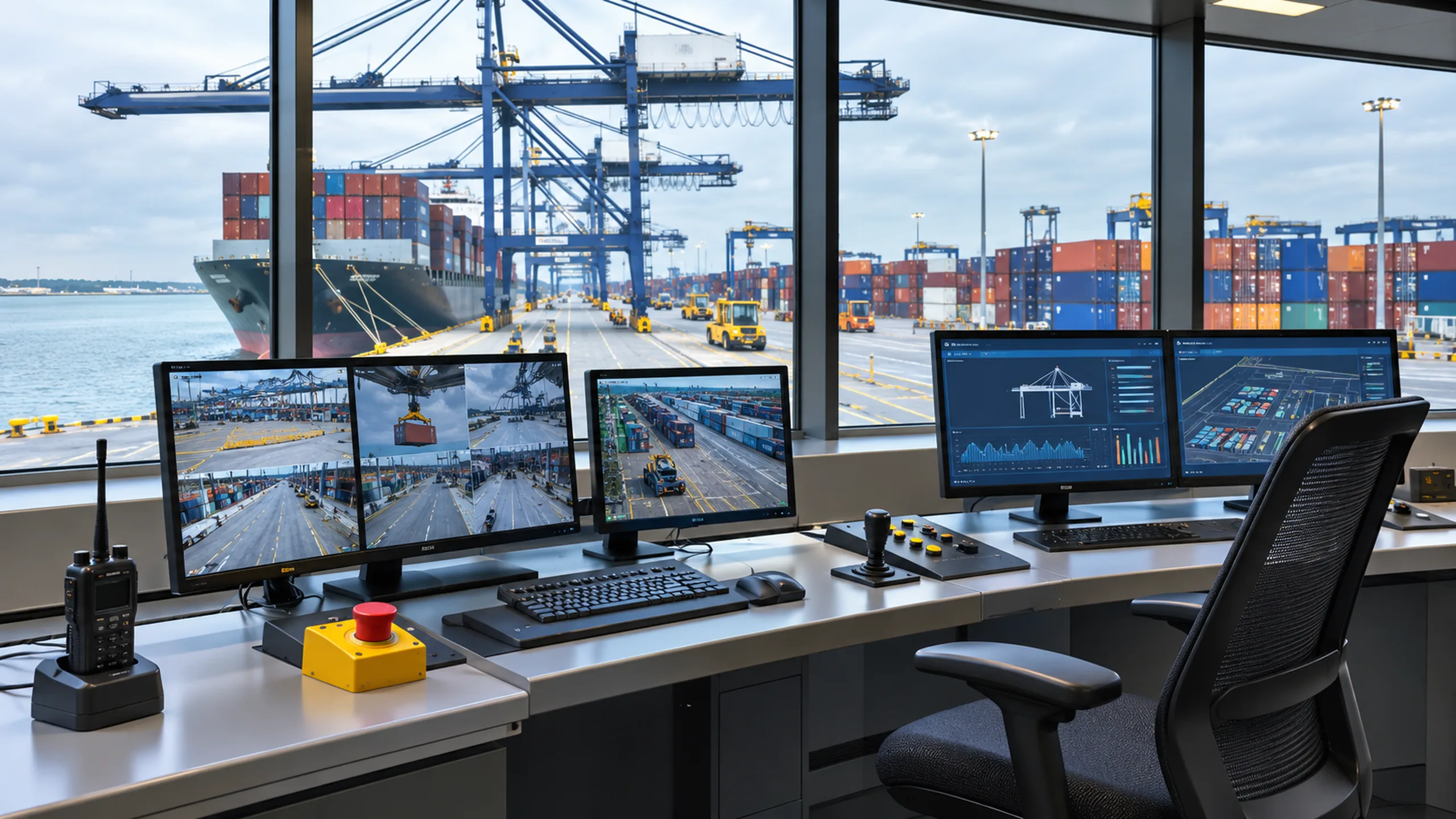
Verification, Human Oversight and Emerging Connectivity Research for Port and Terminal Operations
Physical AI and Artificial Intelligence of Things (AIoT) systems used in port and terminal operations must remain understandable and controllable when observations are uncertain or communications are interrupted. A crane movement, terminal tractor dispatch, container transfer, or remote equipment command depends on timely information, clear operating authority, and confirmation of the resulting physical state. A command acknowledgment alone does not establish that the intended movement occurred.
Contact PortOps AIPortOps AI examines research questions around runtime assurance, operator intervention, independent outcome verification, and communication-aware operation. The focus is on workflows involving ship-to-shore cranes, yard gantry cranes, terminal tractors, reach stackers, straddle carriers, container handling zones, and the operational systems that coordinate them. The appropriate equipment boundary and action authority must be defined for each proposed study.
Why Verification and Oversight Matter In Port Operations
Container terminals operate across large, equipment-dense areas where radio coverage, line of sight, weather, moving machinery, and network load can affect the availability and quality of operational data. A positioning update may arrive after a terminal tractor has moved. A crane status message may be delayed or repeated. A camera view may be obstructed by a container stack, while a wireless sensor reports a condition that conflicts with another source.
These conditions create a difference between what a system has observed, what it has inferred, and what has been independently confirmed. A digital record that a container transfer was requested is not proof that custody changed. A controller acknowledgment is not proof that a crane completed the intended motion. A location estimate is not a substitute for a verified equipment state or a confirmed handoff.
Research in this area asks how software can recognize when its information is no longer adequate, prevent unsuitable commands from proceeding, and provide operators with enough context to intervene. The objective is not to remove people from terminal operations. It is to define where automation is appropriate, when human judgment is required, and what evidence is needed before a workflow resumes.
Runtime Assurance and Independent Verification Of Physical Outcomes
Runtime assurance uses defined checks while a system is operating to determine whether its current state, proposed decision, and permitted actions remain within specified boundaries. For a port equipment workflow, those boundaries may include an authorized equipment identity, a permitted operating zone, a valid command sequence, a current equipment state, and a defined operating mode.
A candidate architecture can separate decision generation from an assurance layer that checks whether the proposed action satisfies the approved conditions. If required information is missing, stale, inconsistent, or outside the evaluated operating envelope, the system can withhold the command, request additional evidence, or escalate the case to an authorized operator. Any fallback behavior must be specified and tested for the equipment and workflow concerned.
Independent verification examines what happened after a command was issued. Depending on the task, evidence may include subsequent position measurements, crane or vehicle telemetry, limit-switch state, camera observations, a confirmed container identity, or a human-verified handoff record. The selected evidence must be independent enough to detect a command that was acknowledged but not completed, partially completed, or completed differently than expected.
Research questions include: Which observations are sufficient to verify a container movement or equipment response? How should the system handle conflicting position and equipment-state signals? What conditions require a hold, a safe fallback, or operator review? How can each decision be traced to the observations, rule set, model version, authorization, command, and outcome evidence that informed it?
Human Oversight and Operator Decision Support
Human oversight is most useful when intervention requests are selective, understandable, and actionable. A terminal control-room operator or shift supervisor should be able to see the affected equipment, the relevant operating context, the information that is uncertain, the proposed response, and the reason the workflow has been paused or escalated. Alerts that do not distinguish urgency or operational consequence can increase workload and make important exceptions harder to identify.
Candidate methods include risk-based escalation, explanation summaries linked to source observations, confidence and data-quality indicators, role-based approval, and structured intervention records. The design should distinguish an operator recommendation from an authorized command. It should also define who can approve, reject, pause, or resume an action, and how that authority is recorded across shift changes.
Human-factors evaluation should consider alert frequency, time to understand an exception, intervention latency, workload across shifts, handoff quality, and the rate of incorrect approvals or unnecessary escalations. Research should examine realistic interruptions and workload peaks, not only idealized operator response times.
Bounded Formal Verification and Foundation-model Interfaces
Formal verification can be useful when a system property can be stated precisely and represented in a tractable model. In a port equipment workflow, a bounded property might specify that a command cannot be dispatched unless the target equipment is identified, the request is authorized, the required interlock state is valid, and the observation is within an agreed freshness limit. The property, model, assumptions, and scope of the check must be stated explicitly.
Research may examine how foundation-model interfaces are constrained when they translate natural-language requests or operational context into structured recommendations. A model-generated output should not itself grant equipment authority. Candidate safeguards include schema-constrained outputs, allow-listed commands, policy checks, explicit authorization services, independent validation, and rejection of ambiguous or incomplete requests.
A formal result applies only to the modeled properties and assumptions. It does not prove that field sensors are accurate, that a terminal network is reliable, that an equipment controller is correctly configured, or that the complete installation is safe. Physical testing, integration review, and applicable engineering approvals remain separate requirements.
Wireless Sensing and Communication-aware Control
Port terminals combine fixed infrastructure with mobile equipment and changing physical obstructions. Wireless sensors, positioning systems, cameras, vehicle telemetry, and equipment controllers may use different networks and update rates. Research should examine how link quality, message delay, packet loss, duplicated events, clock differences, and measurement age affect the decisions that depend on those signals.
Candidate connectivity options may include industrial wireless local area networks, private cellular networks, radio systems, wired backhaul, and satellite links for selected remote or hard-to-reach assets. These are implementation options for evaluation, not a statement that PortOps AI supports or is compatible with a particular network, device, or carrier. Site surveys and interface testing are required to determine suitability.
Integrated sensing and communication (ISAC) is an emerging research area in which communication infrastructure may also contribute to sensing. Its relevance to a port terminal depends on the target task, coverage geometry, equipment environment, interference conditions, available hardware, and evidence that the sensing function is adequate for the intended decision. It should be evaluated against established sensing and communication baselines rather than assumed to improve operations.
Communication-aware control uses the age and quality of information as part of the decision. For example, a movement request based on a stale terminal tractor position may need to be rejected or revalidated. A temporary network outage may require local equipment protections to remain active while higher-level coordination is paused. The response must be specific to the equipment and control architecture; remote connectivity should not replace local safety functions.
Hybrid Terrestrial and Non-terrestrial Connectivity For Remote Assets
Some port-related assets operate beyond the strongest coverage areas of a terminal network, including remote inspection points, isolated monitoring locations, or assets associated with offshore and extended maritime operations. Hybrid terrestrial and non-terrestrial connectivity may be worth evaluating where conventional coverage is limited or where a secondary communications path is required.
The research question is not simply whether a satellite or cellular link is available. It is whether the selected path can deliver the required message priority, timing, availability, cybersecurity controls, and operational context for the task. Latency, bandwidth, weather exposure, antenna placement, power availability, service continuity, and operating cost may constrain the design. Local protections and appropriate autonomy limits must remain effective when the wide-area connection is unavailable.
Proposed Research Demonstration
A controlled demonstration can model a container-handling workflow in which a terminal tractor approaches a transfer zone while a crane or yard system coordinates the next movement. The scenario should represent the relevant equipment states, zone restrictions, identity records, command authority, and expected physical feedback. A simulation or isolated test rig should be used until the relevant interfaces and safeguards have been reviewed for physical testing.
The demonstration should inject communication failures, uncertain observations, and misleading recommendations. Include delayed, dropped, duplicated, and reordered messages; timestamp mismatch; stale location or equipment-state data; conflicting sensor observations; human intervention delay; temporary loss of the primary network; and recovery after connectivity returns. Include both routine operating conditions and stress cases.
Compare a credible baseline, such as fixed workflow rules and existing operator escalation, with a candidate runtime-monitoring and oversight policy. Keep the operating demand and injected disturbances comparable across the baseline and candidate runs. The candidate policy should be evaluated for its ability to detect degraded information, reject stale commands, request human review, preserve required local functions, and verify recovery before normal coordination resumes.
Evaluation Measures
Evaluation criteria should be selected before testing and defined with a unit, denominator, time window, and method of aggregation. Relevant measures include:
Detection coverage: the proportion of defined communication, data-quality, and unsafe-state conditions detected by the assurance logic.
Intervention latency: elapsed time from a defined escalation trigger to an authorized operator response.
Operator workload: alert volume, active review time, concurrent cases, and intervention demand across representative shifts.
Stale-command rejection: the proportion of commands based on observations older than the predeclared freshness limit that are correctly withheld.
Retained functions: the operational functions that remain available during degraded connectivity, with the permitted local behavior stated explicitly.
Recovery: time and conditions required to restore normal coordination after communications return, including checks for message backlog and state reconciliation.
False escalation and missed escalation: unnecessary operator interruptions and conditions that should have triggered review but did not.
Outcome verification: the proportion of eligible actions for which independent evidence confirms the expected physical result.
Report formal assumptions, model boundaries, test coverage, data sources, and evidence gaps. A successful simulation demonstrates behavior only within its modeled conditions. It does not establish field reliability, equipment safety, standards compliance, or operational performance at a customer terminal.
Data, Platform Requirements, and Research Limitations

A study may require timestamped equipment telemetry, controller and gateway events, position or zone observations, wireless link metrics, command and authorization logs, operator intervention records, and independently observed outcomes. Each record should identify its source, time basis, equipment or asset association, quality status, and applicable software or model version. Data access, retention, privacy, and security requirements should be agreed before operational records are used.
The platform may include field sensors, positioning infrastructure, equipment gateways, edge computers, network monitoring, terminal operating systems, and a controlled simulation or test environment. Interfaces to terminal operating systems, equipment controllers, and other enterprise systems must be assessed individually. The presence of a named system or protocol in a research design does not establish an existing connector or tested integration.
Important limitations include incomplete coverage of rare failures, differences between simulated and physical radio behavior, uncertain ground truth for some equipment states, changing terminal layouts, operator workload variation, and the difficulty of reproducing all dependencies in a formal model. Any result should state what was tested, what was assumed, and what remains unverified.
Research Status and Evidence Boundaries
This page presents an industry-specific research direction based on the shared Physical AI and AIoT research agenda. It does not claim that PortOps AI has completed the proposed experiments, built a dedicated assurance product, validated a particular connectivity stack, or deployed the described workflows at a customer terminal. Any future publication of findings should identify whether the evidence comes from an illustrative scenario, an executed simulation using synthetic data, a controlled bench or hardware test, a customer pilot, or an operational customer result.
If a simulation is published, identify its assumptions, generator or model version, test scenarios, baseline, calculated metrics, limitations, and approval record. Do not present synthetic findings as customer results. A controlled test does not establish certification, and formal verification of a specified property does not establish end-to-end field safety.
Discuss A Port Operations Research Question
PortOps AI welcomes technical discussions about verification, operator oversight, and connectivity constraints in port and terminal workflows. A useful starting point is a defined equipment class, operating task, existing communications environment, command authority model, and the evidence required to confirm a physical outcome.
Discuss a port operations research question