IoT Software for Port and Terminal Operations
IoT software connects field observations with operational applications. In a port or container terminal, it can collect device messages, associate them with the correct equipment or operating context, preserve event history, and make information available to the people and systems responsible for daily operations.
Contact PortOps AIThe software layer sits between connected field equipment and the applications that use its data. It does not replace sensors, identification hardware, industrial control systems, or artificial intelligence (AI) models. Its role is to manage the flow and quality of information so that equipment status, movement events, and operating measurements can be reviewed and used consistently.
Connect Field Devices to Terminal Operations
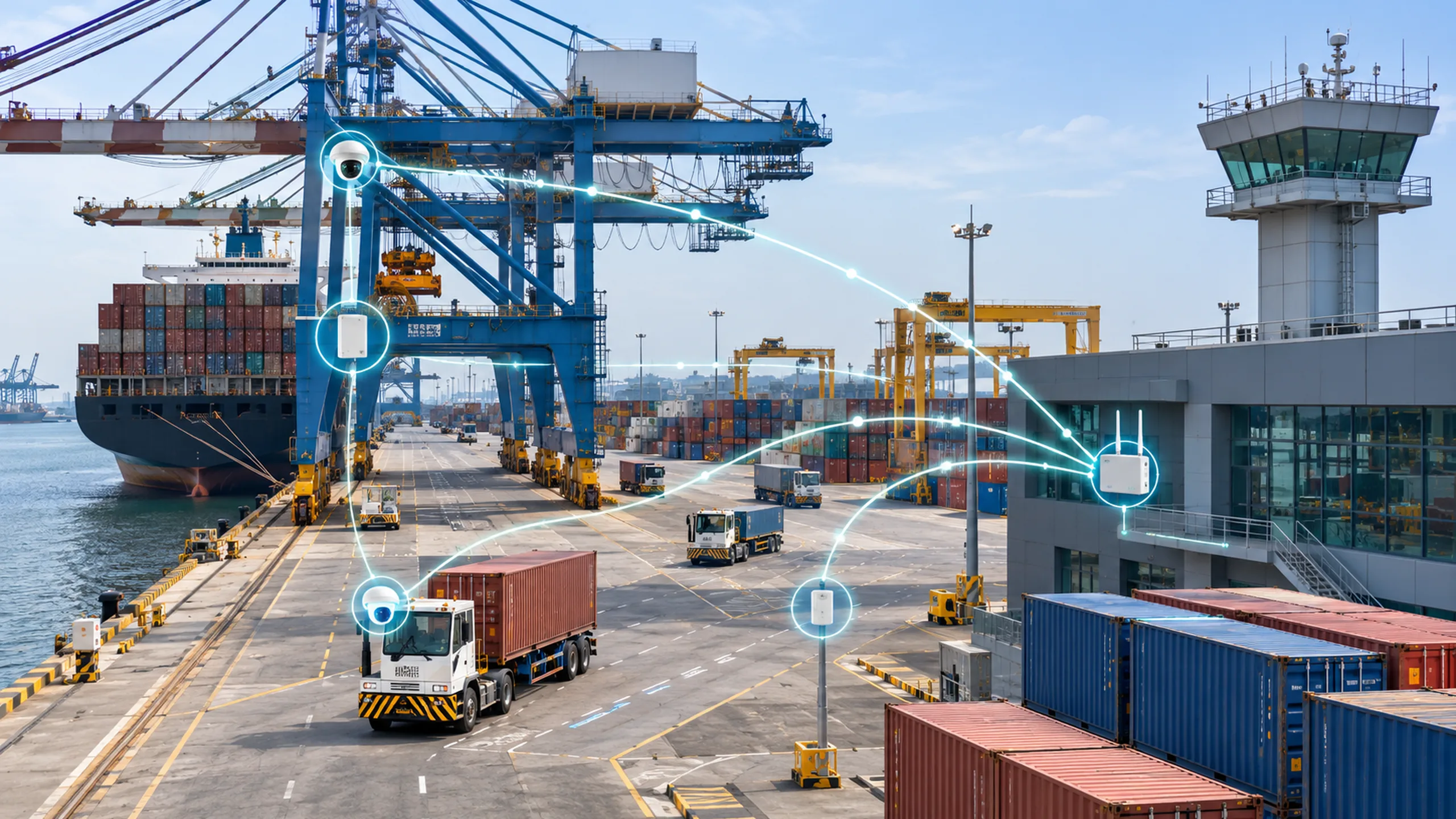
A terminal may generate observations from quay cranes, rubber-tired gantry cranes, reach stackers, terminal tractors, yard vehicles, gate equipment, reefer monitoring devices, environmental sensors, and fixed identification points. The exact device mix depends on the facility, its operating processes, and the information required.
IoT software provides a structured path for receiving those observations. Device adapters or gateways collect messages from the available interfaces and pass them into an ingestion service. The service records the source, event time, receipt time, asset identifier, measurement or event type, value, and applicable quality information.
Associating each observation with a reliable asset record is essential. A vibration reading from a crane drive, a temperature reading from a refrigerated container, and a location event from a terminal tractor describe different operational facts. The software should preserve the identity and context needed to interpret each one.
Ingest Events and Preserve Time Context
Device messages do not always arrive in the order in which events occurred. A gateway may buffer observations during a network interruption and deliver them after connectivity returns. Devices may also use different clocks, sampling intervals, units, or message formats.
An ingestion workflow should retain both the time reported by the device and the time the platform received the message. It should define the time zone or use Coordinated Universal Time (UTC) consistently, validate units, and identify records with missing or implausible timestamps. Delayed delivery should be visible rather than silently treated as a new event.
Duplicate handling requires an explicit rule. Where a device supplies a stable event identifier, the software can use it to recognize repeated delivery. Where it does not, a documented combination of source, asset, event type, and time window may be considered, subject to the risk of merging two legitimate events. The selected rule should be tested against the terminal’s actual message patterns.
Manage the Device Lifecycle
Connected equipment requires ongoing administration after initial installation. A device lifecycle workflow can cover onboarding, asset association, configuration, health monitoring, software or firmware updates, service history, replacement, and retirement.
Onboarding: register a device identity, its assigned asset or location, the responsible owner, and the date it entered service.
Configuration: record approved settings such as reporting intervals, measurement units, thresholds, and communication parameters.
Health monitoring: track last communication, message delays, battery or power status where available, sensor diagnostics, and gateway connectivity.
Updates: document the update package, target device group, approval, maintenance window, outcome, and recovery action if an update fails.
Maintenance records: link inspection, calibration, repair, replacement, and decommissioning events to the device and associated equipment.
These records help operations technology and maintenance teams distinguish an equipment condition from a data-collection problem. For example, an absent crane measurement may indicate a stopped asset, a failed sensor, a disconnected gateway, or delayed message delivery. The software should expose the available evidence and avoid treating every missing reading as an equipment fault.
Maintain Usable Operational Data
IoT data services should retain a history of measurements and events with enough context for review and downstream use. Common services include filtering, validation, quality flags, duplicate detection, event ordering, storage, retrieval, and retention controls.
Quality flags can identify missing values, out-of-range readings, stale observations, clock inconsistencies, suspected sensor drift, and records received after a prolonged interruption. Filtering should preserve the original record or an auditable reference to it so that users can understand how a displayed value was derived.
Retention should reflect operational need, investigation requirements, system capacity, contractual obligations, and approved privacy and security policies. Access to equipment and personnel-related records should be limited to authorized roles. Retention periods and access rules must be agreed for the actual deployment rather than assumed to be universal.
Support Operational Visibility and Follow-Up
Dashboards can present equipment connectivity, recent events, measurement trends, data-quality status, and unresolved exceptions. A terminal operations supervisor may need a concise view of delayed or missing events, while a maintenance planner may need a longer history of crane or vehicle condition measurements. Views should be designed around the decisions and tasks of each user group.
Notifications can route defined exceptions to the responsible team. Each notification should identify the affected asset, the observed condition, the time context, the source, and the action expected from the recipient. Alert rules should be reviewed for duplicate messages, unnecessary escalation, and situations in which the underlying data is stale or incomplete.
Permissions and audit trails are important where users acknowledge events, change device configuration, approve updates, or close maintenance records. The system should record who performed an action, when it occurred, what changed, and whether the action was completed or rejected.
Connect IoT Middleware with Enterprise Systems
IoT middleware and interfaces move device information into the applications that need it. Depending on the facility architecture, downstream destinations may include a terminal operating system (TOS), computerized maintenance management system (CMMS), enterprise resource planning (ERP) system, warehouse or yard applications, reporting services, or a data platform. The presence of a system in this list does not imply that a connector is already available.
An integration contract should define asset identifiers, event names, timestamps, units, required fields, validation rules, error responses, and ownership of each data element. It should also specify how rejected records are reported and corrected, how delayed messages are replayed, and how system outages affect data delivery.
IoT software is distinct from the AI models that may analyze its data and from the physical devices that generate observations. It can prepare and route information for an AI decision function, but it does not by itself establish model accuracy or authorize a physical action. Likewise, receiving a command acknowledgment is not proof that a crane, vehicle, or other asset reached the requested physical state.
Illustrative Port Data Flow
The following sequence shows one possible flow for a terminal tractor location event. It is an illustrative architecture, not a statement that a specific device, protocol, connector, or production deployment is currently supported.
A positioning device or approved location source produces an observation for a terminal tractor.
A field gateway or device adapter receives the message and forwards it to the IoT ingestion service.
The ingestion service validates the timestamp, unit, source, and asset association, then applies the documented duplicate-handling rule.
The event is stored with its quality status and made available to an operations view or an approved enterprise interface.
A terminal supervisor reviews an exception if the event is delayed, missing, or inconsistent with the expected movement record.
Plan for Connectivity, Reliability, and Deployment
IoT software design should reflect the terminal’s physical environment and network conditions. Coverage may vary between quay areas, container stacks, equipment routes, maintenance facilities, gates, and indoor operating spaces. Metal structures, moving equipment, interference, weather exposure, power availability, and maintenance access can affect device communications.
A deployment assessment should establish the required data latency, message volume, device count, operating hours, outage behavior, local buffering needs, and retention period. Edge processing may be appropriate where local response or continuity is important, while server or cloud services may support broader aggregation and enterprise access. The actual placement of services depends on the facility’s security, availability, data-governance, and integration requirements.
Before implementation, confirm the device inventory, available interfaces, network coverage, cybersecurity requirements, system owners, data responsibilities, and support model. Test normal operation as well as delayed delivery, duplicate messages, invalid units, clock mismatch, gateway interruption, device replacement, and recovery after an outage.
Implementation Boundaries and Evidence
The software architecture and workflows described here are implementation considerations. Specific supported devices, protocols, connectors, update mechanisms, deployment options, and production capabilities must be confirmed against a current technical and capability register before they are presented as available PortOps AI functionality.
A pilot should use an agreed set of assets and workflows, documented data definitions, representative operating conditions, and a baseline process. Useful evaluation measures may include event completeness, duplicate-event rate, asset-association errors, message delay, device availability, time to identify a data-collection fault, and effort required to reconcile exceptions. Define each measure, its denominator, and the evaluation period before testing.
Discuss Your IoT Software Requirements
Every terminal has a different combination of equipment, networks, operating systems, and information requirements. Discuss the devices you need to connect, the events and measurements that matter, the applications that must receive the data, and the constraints that shape deployment.
Contact PortOps AI to discuss your IoT software requirements