
Cybersecurity and Physical Action Safeguards for Port and Terminal Operations
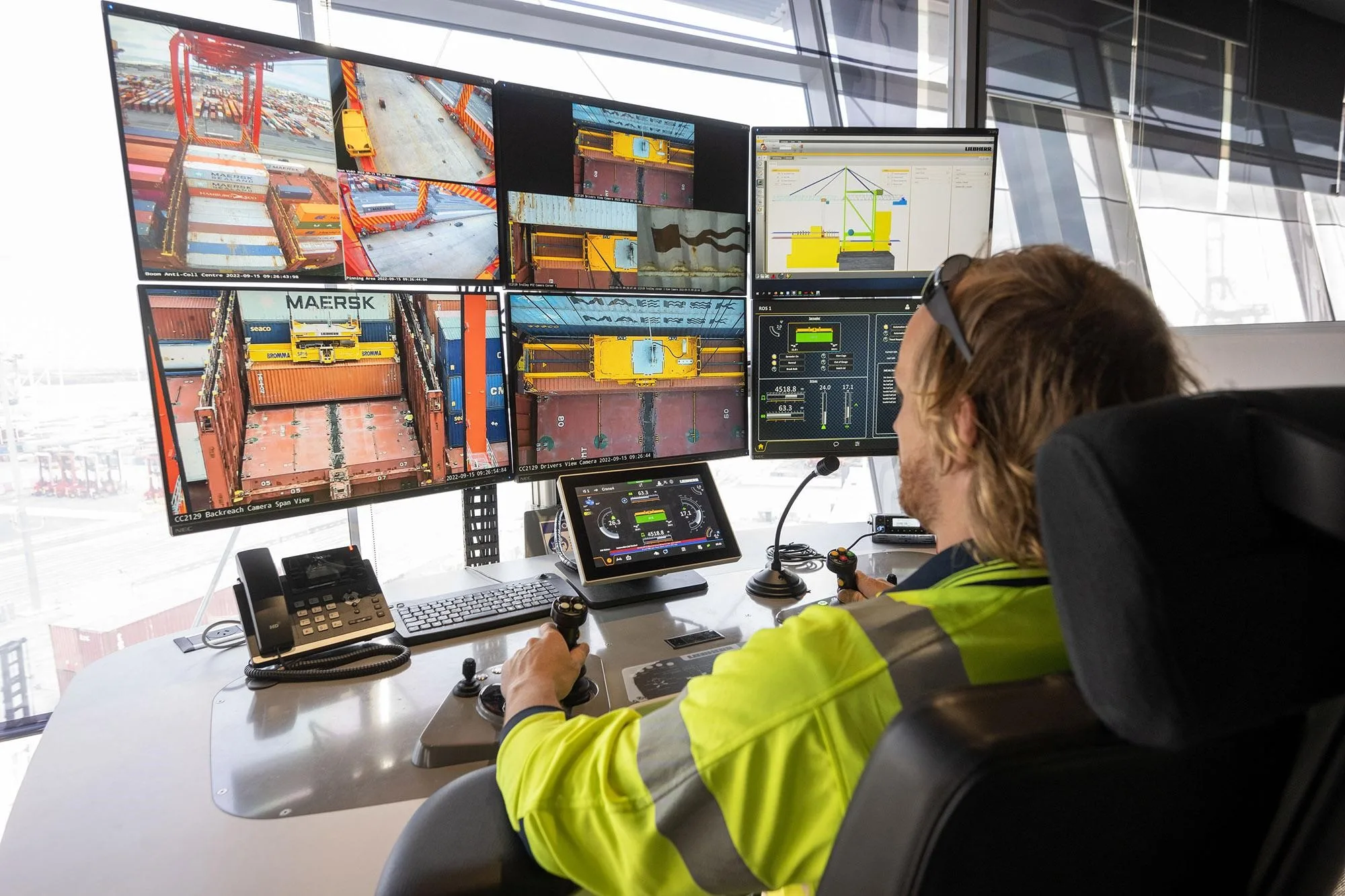
Connected port systems need controls for both information access and operational execution. Terminal operating systems, crane control networks, gate automation, equipment gateways, sensors, and remote operating stations exchange data that can influence how cargo and machinery move. A cybersecurity incident can therefore affect more than business information. It can disrupt terminal workflows or create unsafe operating conditions.
Contact PortOps AIA sound design starts by mapping the systems and connections that support a defined operation. It then limits who and what can communicate, protects the integrity of observations and commands, and establishes how equipment responds when information or communications cannot be trusted. Where a decision can affect a physical process, the design must also define authority, operating limits, independent protective functions, human intervention, and evidence of the resulting state.
Cybersecurity controls reduce the likelihood and impact of unauthorized access or manipulation. They do not, by themselves, establish that a crane, automated guided vehicle (AGV), gate barrier, conveyor, or other equipment is safe to operate. Equipment safety and control-system assurance require site-specific engineering, testing, and approval.
Map the Port OT System Boundaries
Begin with an inventory of the assets and data flows involved in the selected terminal workflow. The boundary may include enterprise applications, the terminal operating system (TOS), industrial data services, remote operation consoles, crane control systems, programmable logic controllers (PLCs), field sensors, wireless networks, maintenance laptops, and vendor support connections.
For a container terminal, a practical map may include ship-to-shore (STS) cranes, rubber-tired gantry (RTG) cranes, automated stacking cranes, terminal tractors, AGVs, optical character recognition (OCR) portals, gate systems, reefer monitoring, and yard-positioning services. Bulk terminals may add conveyors, ship loaders, weighbridges, pumps, valves, and environmental monitoring. Include only equipment and interfaces that are actually within the facility’s scope.
Document the purpose and owner of each connection. Record which systems provide observations, which systems make or support decisions, and which interfaces can issue commands. Identify external access paths, wireless bridges, engineering workstations, shared service accounts, cloud or server dependencies, and connections to port community or logistics systems. A network diagram should show trust boundaries and required data flows, not simply list devices.
Separate enterprise IT from operational technology (OT) according to operational risk and required communications. A demilitarized zone (DMZ) or equivalent controlled exchange layer can mediate approved data flows between business systems and industrial networks. Segmentation should reflect the terminal’s real architecture, availability needs, safety requirements, and maintenance practices. Do not assume that a network is protected merely because it is described as isolated or air-gapped.
Apply Identity, Access, and Network Controls
Every user, device, application, and service that connects to an operational environment should have an identifiable owner and an approved purpose. Avoid shared accounts where individual accountability is required. Use role-based access and least privilege so that an account can reach only the systems and functions needed for its assigned work.
- Identity and authentication: use unique user and device identities, strong authentication, and multifactor authentication for remote access where supported and operationally appropriate. Define how accounts are issued, reviewed, disabled, and removed.
- Privileged access: restrict administrator and engineering privileges. Use controlled workstations or jump hosts for approved maintenance access, record sessions where appropriate, and make access time-limited and tied to a work order or approved task.
- Network segmentation: separate business IT, industrial services, control networks, safety-related systems, wireless device networks, and third-party access paths according to the site risk assessment. Permit only required source, destination, protocol, and direction combinations.
- Protected communications: use secure protocols and cryptographic protection where supported by the equipment and performance requirements. Document legacy devices and protocols that cannot support modern protections, and apply compensating controls.
- Logging and monitoring: record authentication, privilege changes, configuration updates, remote sessions, security events, and command-related events. Synchronize clocks across systems where feasible so incident timelines can be reconstructed.
- Device and software lifecycle: maintain an OT asset inventory, track firmware and software versions, assess vulnerabilities, test updates before deployment, and document patch deferrals when availability or vendor constraints prevent immediate changes.
Remote vendor access deserves particular attention. Require a documented business need, named approval, a defined time window, least-privilege scope, strong authentication, and monitoring. Disable dormant accounts and remove temporary access when the work is complete. Do not expose control devices directly to the public internet.
Protect the Integrity of Observations and Decisions
Physical AI and Artificial Intelligence of Things (AIoT) applications depend on observations from identification devices, sensors, cameras, positioning systems, and equipment telemetry. If an input is stale, misassociated, manipulated, or incomplete, a downstream recommendation or action may be wrong even when the decision software is functioning as designed.
Associate each operational observation with its source, asset identity, timestamp, unit, quality status, and relevant operating mode. Retain information about sensor health, calibration status, data transformations, and model or ruleset version where applicable. Validate asset identity and event sequence before using a reading to authorize an action.
For example, a yard crane movement request should not rely solely on an old position report or a container identity inferred from a single uncertain read. The workflow should detect stale or conflicting observations, request confirmation when necessary, and abstain from issuing an action when required information is missing or outside the conditions that were evaluated.
Treat AI outputs as decision inputs, not as independent authority. Define confidence thresholds, operating envelopes, escalation paths, and conditions under which the system must stop recommending or initiating a response. Preserve a traceable record connecting the observation, decision, approval, command, and subsequent outcome.
Separate Cybersecurity Checks from Equipment Safety Functions
A permission check answers whether a user or software service is allowed to request an operation. A software validation check can determine whether a command has the expected format, target, timing, and permitted operating range. Neither check replaces the equipment’s engineered safety functions.
For cranes and other cargo-handling equipment, independent protective functions may include emergency stops, travel and hoist limits, anti-collision systems, load-related protections, access interlocks, and other safeguards defined by the equipment design and applicable engineering requirements. The exact protections vary by machine and installation. They must be assessed and validated by qualified personnel rather than assumed from a generic software architecture.
Keep supervisory decision services separate from low-level equipment control loops. A Physical AI or AIoT application may propose a movement, request a work order, or send a bounded command through an approved interface. The site’s control system and protective functions must retain their assigned authority. A workflow request is not the same as direct physical control, and a command acknowledgment is not proof that the requested movement occurred.
Define the operating mode explicitly: advisory only, operator-mediated, operator-approved execution, or bounded autonomous execution. Specify who can change modes, how the mode is displayed, what conditions suspend execution, and how a human operator can intervene. Any autonomous scope requires formal engineering review, documented limits, and site acceptance testing.
Build Safeguards into the Physical Action Path
A controlled action path should make each decision point visible and auditable. For a defined crane, gate, conveyor, or vehicle workflow, document the following sequence:
- Propose: create a command proposal with a unique identifier, target equipment, requested action, reason, source observations, and applicable model or ruleset version.
- Authorize: authenticate the requesting service and user, confirm the assigned role and operating mode, and obtain the required operator approval.
- Validate: check that observations are current, the equipment is in an eligible state, the target is correct, and the request remains within approved operating limits.
- Dispatch: send the approved request through the designated gateway or controller interface. Apply duplicate-request protection and defined timeout handling.
- Acknowledge: record whether the receiving system accepted, rejected, or failed to acknowledge the request. Treat acceptance as a communication event, not as proof of physical completion.
- Verify: use independent position, state, sensor, or operator confirmation to determine whether the expected physical outcome occurred. Record partial, failed, and unverified outcomes distinctly.
The action path should also define who can cancel a request, how an operator override is recorded, and what happens when a command is repeated, delayed, rejected, or interrupted. A retry must not create duplicate physical movement. Where the state is uncertain, the system should hold, request renewed confirmation, or move to a site-approved fallback rather than assume success.
Prepare for Faults, Manipulated Inputs, and Communication Loss
Security and operational reviews should test realistic failure scenarios, not only normal message exchange. The relevant cases depend on the equipment and workflow, but port and terminal teams should consider:
- Stale or conflicting observations: reject or quarantine data that exceeds the approved age or consistency limits. Request a fresh observation or human confirmation.
- Invalid or unauthorized commands: deny the request, preserve the event record, alert the responsible owner, and prevent an alternate interface from bypassing the same authorization boundary.
- Compromised credentials or remote sessions: revoke affected access, isolate the affected path where safe, preserve logs, and follow the facility incident-response plan.
- Manipulated sensor or positioning data: compare independent sources where practical, flag improbable state changes, and prevent unverified inputs from authorizing movement.
- Network or gateway outage: define which functions continue locally, which buffer data, which degrade to manual operation, and which stop. Confirm that local protective functions do not depend on an unavailable external service.
- Partial execution or missing feedback: mark the outcome as unverified, prevent blind retries, notify the operator, and require a defined recovery procedure.
- Unauthorized physical access: coordinate cybersecurity controls with facility access control, equipment cabinet security, maintenance procedures, and physical inspection.
Incident response must account for operational consequences. Disconnecting a device or network segment may be appropriate in some cases, but an abrupt isolation can also affect active equipment or essential monitoring. Predefine decision authority and coordination between the security operations team, terminal operations, OT engineering, equipment maintainers, and facility safety personnel. Recovery and restart should include verification of system integrity and equipment state.
Implementation Checklist for Port and Terminal Teams
Use this checklist when reviewing a new connected system, remote operating capability, AI-supported decision workflow, or equipment command interface. Assign an owner and retain evidence for each item.
- System boundary: inventory relevant devices, applications, network links, external interfaces, physical access points, and administrative paths.
- Ownership: name the business owner, OT engineering owner, cybersecurity owner, equipment maintainer, and operational approver.
- Identity and access: verify named accounts, role permissions, privileged access controls, remote access approvals, and account removal procedures.
- Network design: document trust zones, approved data flows, segmentation enforcement, wireless coverage, and dependencies on external services.
- Data integrity: define asset identity, timestamps, data quality checks, sensor health, model or ruleset versions, and stale-data behavior.
- Command authority: specify who or what may request, approve, dispatch, cancel, and override each action.
- Equipment protections: identify applicable interlocks and independent safety functions, and obtain engineering evidence that they remain effective.
- Fault response: test denied commands, invalid inputs, duplicate requests, communication loss, partial execution, manual fallback, and recovery.
- Audit evidence: retain access logs, configuration changes, decision records, command identifiers, acknowledgments, observed outcomes, and approval records.
- Change management: assess software, firmware, network, model, and equipment changes before release; test rollback and restoration procedures.
- Acceptance: record test conditions, limitations, unresolved risks, responsible approvers, and the conditions required before expanding the system’s scope.
A checklist is a starting point, not a substitute for a facility-specific risk assessment. Prioritize controls according to the consequence of unauthorized access, incorrect data, equipment malfunction, and loss of essential services. Validate safeguards with the equipment manufacturer, qualified OT engineers, cybersecurity specialists, and the site’s safety authority as appropriate.
Related Resources
Discuss Your Port OT Security Requirements
Every terminal has a different mix of equipment, network architecture, operating procedures, and safety requirements. PortOps AI can help your team frame a focused discussion around a defined workflow, the data and interfaces it depends on, and the safeguards required before any physical action is considered.
Discuss your port and terminal requirements