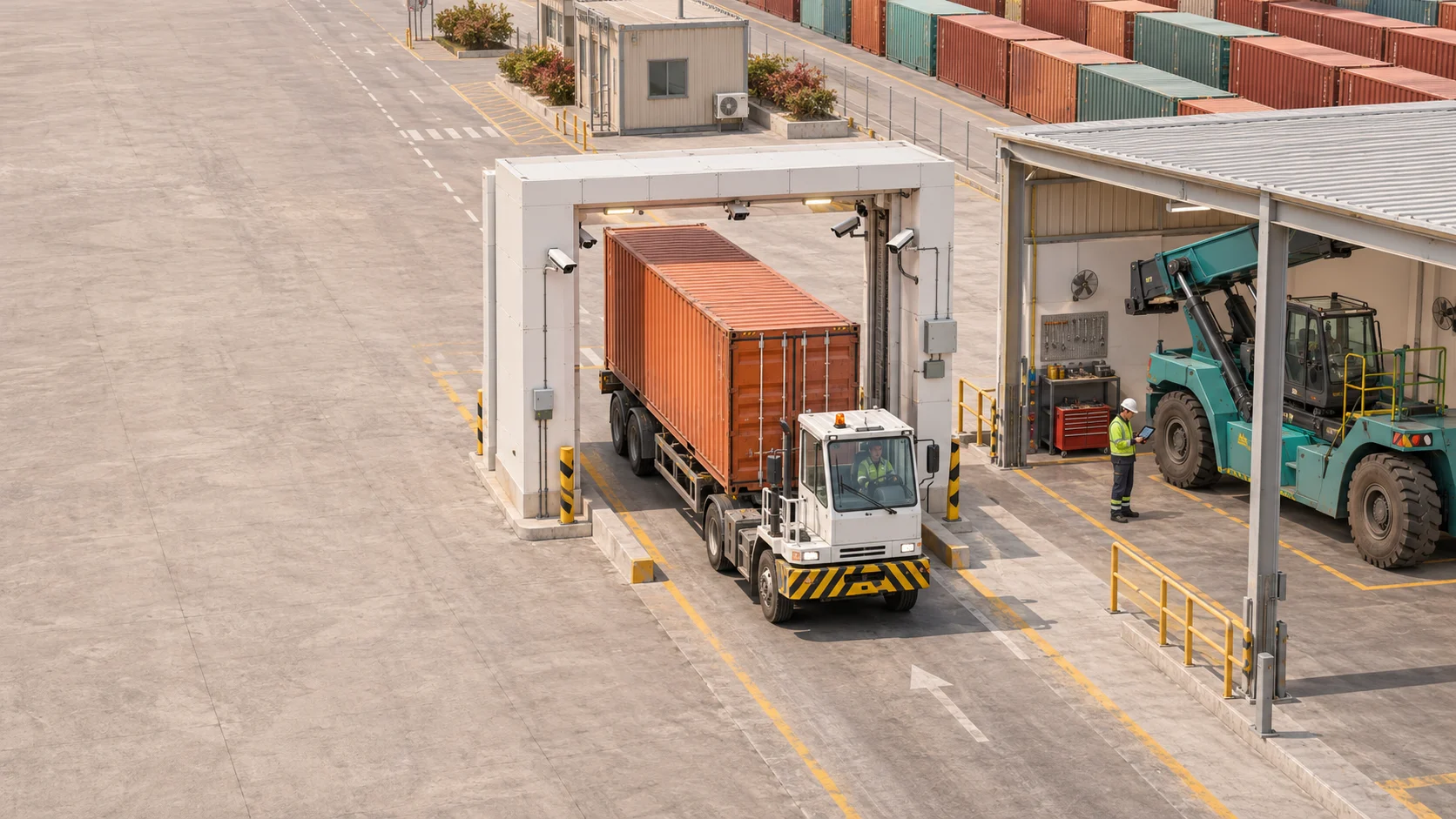
AI-enabled inspection at a container terminal

Physical AI and AIoT Solutions for Port and Terminal Operations

Port and terminal operations depend on accurate information about containers, cargo movements, handling equipment, and the condition of critical assets. Physical AI and the Artificial Intelligence of Things (AIoT) can connect identification, sensing, analysis, and authorized operational responses so teams can evaluate conditions with better context and act on exceptions through defined workflows.

Discuss Your Application

PortOps AI focuses on solution areas relevant to container terminals, marine terminals, and intermodal port facilities. These include container and equipment traceability, condition monitoring for cargo-handling machinery, inspection workflows, maintenance decision support, and operational optimization. The right starting point depends on the operating problem, the equipment involved, available data, existing terminal systems, and the level of authority appropriate for any physical action.

Typical stakeholders include terminal operations managers, vessel and yard planners, quay and yard supervisors, equipment maintenance teams, safety personnel, and information technology and operational technology (IT/OT) teams. Their priorities may include reducing uncertainty around container handoffs, identifying equipment conditions that need review, coordinating maintenance, and understanding where operational decisions are delayed by incomplete or conflicting information.

Solution Areas for Port and Terminal Operations

Each solution area below addresses a distinct operational need. The descriptions are solution concepts for assessment and planning. Specific hardware compatibility, software integrations, deployment readiness, and customer results must be confirmed for the intended terminal before they are represented as supported capabilities.

Asset Tracking and Container Traceability

Connect container, chassis, and handling-equipment identity with movement and handoff events across gate lanes, interchange points, quay areas, and container yards. Depending on the workflow, identification options may include radio-frequency identification (RFID), Bluetooth Low Energy (BLE), ultra-wideband (UWB), or computer vision. The design must account for missed reads, duplicate observations, timestamp differences, incorrect asset associations, and confirmation that a transfer actually occurred.

View this solution area

Pilot question: Can the selected observation points capture the required gate, interchange, and yard events with acceptable event completeness and reconciliation effort?

Cargo-Handling Equipment Condition Monitoring

Associate equipment identity and operating context with measurements from selected assets such as ship-to-shore cranes, rubber-tired gantry (RTG) cranes, rail-mounted gantry (RMG) cranes, reach stackers, empty-container handlers, and terminal tractors. Candidate measurements may include vibration, temperature, electrical behavior, hydraulic pressure, and other variables selected through an equipment review. Alerts should distinguish measured conditions from inferred faults and route findings to the responsible maintenance or operations team.

View this solution area

Pilot question: Are the available measurements representative of the equipment operating modes, and can alerts be reviewed against inspection findings and maintenance records?

Predictive Maintenance Decision Support

Use equipment condition history, operating hours or cycles where available, fault records, and maintenance history to help prioritize inspection and maintenance work. The method must match the evidence available. Anomaly detection, failure-risk estimation, and remaining-useful-life prediction are different functions and should not be presented as equivalent. A pilot should test whether the data includes enough labeled failure and repair history to support the selected method.

View this solution area

Pilot question: Do equipment histories and maintenance records contain sufficient, consistently labeled evidence to evaluate a maintenance prediction against the current planning process?

Inspection and Quality Intelligence

Organize inspection information for defined port assets, cargo-handling components, container condition checks, and operating-area observations. Depending on the inspection task, inputs may include images, thermal readings, acoustic measurements, or other sensor records. AI-supported assessment can help prioritize review, but uncertain findings, false accepts, and false rejects must remain visible to qualified personnel.

View this solution area

Pilot question: Can representative inspection samples cover the relevant defect classes, viewing conditions, equipment states, and acceptance criteria?

Operational Optimization and Authorized Physical Action

Evaluate operational decisions involving equipment availability, yard activity, movement priorities, resource allocation, and response timing. Optimization should state its objective and constraints, such as equipment availability, safe operating zones, traffic rules, and service priorities. Any physical action requires a defined target, command interface, authorization model, independent protective functions where required, and a check of the resulting physical state.

View this solution area

Pilot question: Can the proposed decision be tested against a credible baseline while recording constraint violations, rejected commands, human interventions, and verified outcomes?
Compare Solution Requirements Before Selecting a Pilot

Start with one defined workflow and the operational decision it needs to support. The following comparison helps identify the information, response path, and evidence required before a pilot is scoped.

Buyer problem Required information Decision or response Intended outcome Pilot question Evidence status
Container, chassis, or equipment movement is difficult to reconcile Identifiers, reader or camera observations, location zones, event times, gate and interchange records Review a missing or conflicting event; request handoff confirmation More complete and traceable movement records Can required events be observed and reconciled across the selected transfer points? Proposed solution area; validate site coverage and integration.
Equipment condition is not consistently visible Asset identity, sensor readings, operating mode, sensor health, maintenance context Flag an abnormal measurement for review Earlier visibility into selected condition changes Do readings remain useful across equipment modes, shifts, and environmental conditions? Proposed solution area; validate sensors, baselines, and alert handling.
Maintenance priorities rely on incomplete condition history Condition trends, failure records, operating history, work orders, repair outcomes Prioritize inspection or maintenance review More evidence-informed maintenance planning Is the history sufficiently complete and labeled to evaluate the chosen prediction method? Developing concept; prediction scope depends on evidence readiness.
Inspection findings are difficult to standardize Representative images or measurements, defect labels, acceptance criteria, inspection context Route uncertain or flagged findings to qualified staff More consistent review and traceable findings Do test samples represent real operating conditions and relevant defect classes? Proposed solution area; field performance not established.
Operational decisions must account for changing constraints Equipment availability, work queues, movement state, operating rules, permissions, feedback Recommend an action or submit an authorized command Better-informed allocation and controlled execution Can the decision be compared with a baseline and the physical outcome independently verified? Proposed solution area; no autonomous-control claim is made.

How to Assess and Implement a Port Operations Solution

A practical evaluation begins with the terminal workflow, not a predetermined device or software package. The assessment should identify the assets, observation points, users, data sources, interfaces, operating constraints, and measures that determine whether the proposed approach is useful.

  1. Define The Operational Boundary

    Select the terminal area and workflow, such as gate entry, container interchange, quay-to-yard transfer, yard storage, equipment inspection, or maintenance planning. Identify the asset classes, operating shifts, users, and decisions within scope.

  2. Review Available Data and Observation Coverage

    Inventory container and equipment identifiers, event records, sensor histories, inspection images, maintenance logs, and relevant terminal operating system (TOS) records. Check timestamps, units, asset associations, missing events, duplicate messages, data ownership, and access permissions.

  3. Map Integrations and Deployment Dependencies

    Identify the terminal operating system, gate management, equipment controllers, maintenance or enterprise asset management systems, and other interfaces that are actually present and accessible. Decide whether processing belongs on field devices, edge equipment, a customer-managed server, or cloud infrastructure after reviewing latency, connectivity, security, and support requirements. A named system or protocol is an integration option until compatibility is tested.

  4. Establish A Baseline and Pilot Measures

    Document the current workflow before testing a candidate method. Select measures appropriate to the use case, such as event completeness, false-event rate, reconciliation time, alert rate per operating hour, detection delay, inspection review time, maintenance workload, rejected commands, and independently verified action outcomes. Define units, denominators, time windows, exclusions, and acceptance criteria.

  5. Test Representative and Degraded Conditions

    Include normal operations and realistic exceptions such as missed observations, duplicate events, stale readings, sensor drift, delayed messages, connectivity loss, incorrect asset associations, and operator review delays. Keep simulated findings clearly identified and separate from field measurements.

  6. Review Readiness Before Deployment

    Confirm technical performance, user adoption, cybersecurity, safety review, maintenance responsibility, data retention, training, fallback behavior, and the process for handling uncertain results. Do not move from a software demonstration to physical control without the required engineering validation and approvals.

Evidence, Capability Status, and Customer Validation

The source material for this page does not provide verified PortOps AI customer deployments, measured operational results, certified equipment integrations, or completed field demonstrations. The solution areas are therefore presented as proposed areas for evaluation, not as claims of production availability or proven performance.

Where a study uses synthetic operational data, label it “Simulation-Based Case Study.” State the modeled setting, assumptions, method, run scope, calculated measures, and limitations. A simulation can help assess a proposed workflow, but it does not establish field performance or a customer deployment. A customer pilot must test the assumptions using authorized, site-specific data and operational participation.

For physical actions, distinguish recommendations, human-approved commands, and bounded autonomous execution. A command acknowledgment is not proof that equipment completed the requested action. Verification should use an independent observation of the resulting equipment or process state. Existing protective systems and authorized personnel retain their defined roles.

Explore Applications and Engine Architecture

Explore the broader Physical AI and AIoT Applications directory for workflows that connect identification, sensing, decision support, and operational response.

Learn how the functional components fit together in the Physical AI and AIoT Engines overview.

For a focused discussion of equipment, data, or integration requirements, contact PortOps AI.

Discuss Your Port or Terminal Application

Describe the operating problem, the terminal area, and the equipment or workflow involved. Include the data sources and systems available, the decision that needs support, and how the result would be evaluated. PortOps AI can use this context to identify the relevant solution area and the questions that should be resolved before a pilot is defined.

Discuss Your Application
Scroll to Top