
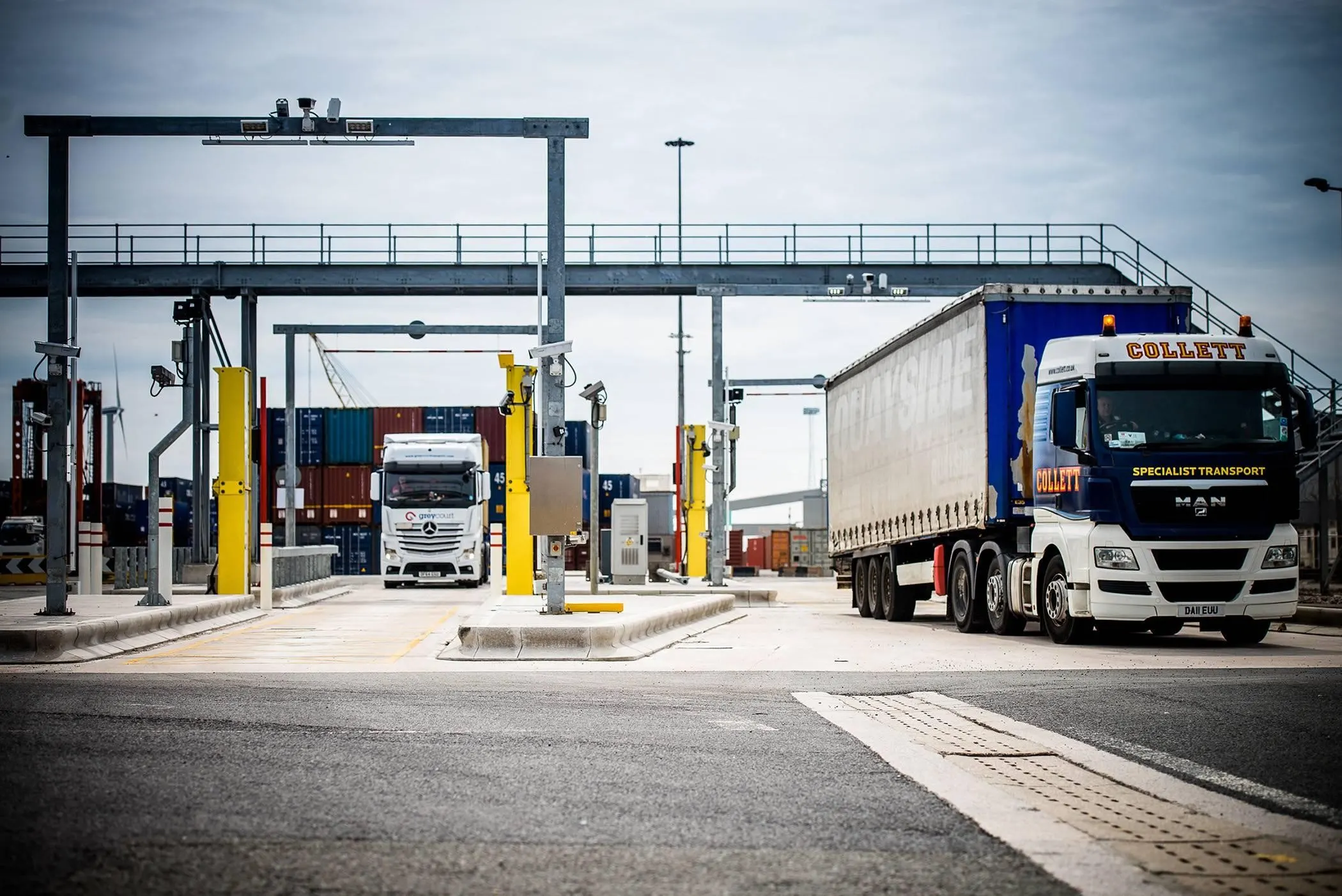
Authorized Physical Action for Port & Terminal Operations
Physical AI can connect operational decisions with carefully bounded actions in a port or container terminal. A practical starting point is a controlled gate-release workflow: verify a truck and its scheduled visit, confirm that the access lane is clear, obtain the required authorization, and then issue a command to raise the vehicle barrier. The system must also confirm the barrier’s physical position before the truck proceeds.
This is an illustrative application design, not a claim that PortOps AI currently controls terminal barriers or has a certified gate-control deployment. The equipment, interfaces, safety functions, and operating rules must be assessed with the terminal operator before any physical connection is considered.
Contact PortOps AIA bounded action at the terminal gate
A vehicle entry or exit lane is a defined operating boundary with a clear target, a limited action, and observable completion conditions. The action considered here is raising one access barrier for one verified truck movement. It does not extend to controlling quay cranes, rubber-tired gantry cranes, ship-to-shore cranes, terminal tractors, or other cargo-handling equipment.
The workflow may involve a truck driver, gate clerk or gate operator, terminal security, the gate operating system, and an authorized operations supervisor. Depending on the facility, the relevant equipment may include a barrier arm and drive, programmable logic controller (PLC), vehicle-presence loop, photoelectric safety sensor, camera or license-plate recognition system, radio-frequency identification (RFID) reader, and barrier position switches. These are candidate components for assessment, not a statement of compatibility or existing integration.
A release decision should be tied to a specific truck, visit, lane, and transaction. The terminal’s operating rules determine whether the action can be automatic within a tightly defined envelope or requires a gate operator’s approval. Exceptions such as an unmatched appointment, a damaged seal, an inspection hold, a lane obstruction, or a conflicting access record should remain outside the automatic release path.
Establish the decision basis before issuing a command
The decision layer should combine current physical observations with the terminal’s operating context. A candidate release decision may use:
- Truck identity and visit information from an approved gate transaction, RFID credential, or license-plate recognition result.
- Lane occupancy and approach status from vehicle-presence loops, photoelectric sensors, or another site-approved detection method.
- The barrier’s current state, local fault status, and any active maintenance or access restriction.
- Terminal business rules, including appointment status, direction of travel, inspection holds, and the permissions assigned to the responsible role.
- Observation timestamps and quality indicators so that stale, incomplete, duplicated, or conflicting records do not authorize movement.
Rules should define what the system does when evidence is incomplete. A stale vehicle read, uncertain identity match, unavailable lane sensor, or disagreement between the gate record and the physical lane state should cause the request to be held or escalated. An AI model may help identify exceptions or recommend a next step, but its output should not bypass required site rules, operator authority, or independent protective functions.
The decision record should identify the source observations, rule or model version, operating context, requested action, and the person or policy that authorized it. The system should distinguish a recommendation from an approval and an approval from an executable command.
Connect authorization to the equipment interface
After authorization, an integration service can prepare a command for the site-approved gate controller. The interface should identify the target barrier and transaction, validate that the request is current, and prevent the same request from being executed twice. The command path may pass through an industrial gateway or controller interface, but the exact architecture depends on the installed barrier equipment and the terminal’s operational technology (OT) environment.
A command acknowledgment confirms only that a message was received or accepted at a particular interface. It does not prove that the barrier moved, reached the requested position, or remained in that position. The application should therefore keep command status separate from physical outcome status.
A timeout, rejected command, controller fault, or communications interruption should not trigger repeated blind retries. The system should check the latest available equipment state, apply the site-defined recovery procedure, and notify the responsible operator. If the state cannot be established, the lane should remain under the terminal’s approved manual or fail-safe procedure.
Human oversight, protective controls, and operating limits
The terminal operator remains responsible for defining who may authorize a release and under which conditions. Human-mediated operation, human-approved commands, and bounded autonomous execution are different operating modes and should be documented separately. A pilot should begin with a mode that allows staff to review recommendations and approvals before any command is sent.
The barrier controller’s local safety functions and any required independent protective devices must remain effective regardless of the AI or application layer. Examples may include obstruction detection, emergency stop, local manual control, interlocks, and manufacturer-defined operating limits. Their actual presence and suitability must be confirmed at the site. Software checks are not substitutes for engineered safety functions, and a software demonstration does not establish that a physical installation is safe or certified.
Human override must be available through the facility’s established operating procedure. The design should record who invoked an override, the reason where practical, the equipment state at the time, and how normal operation was restored. Access permissions should follow least-privilege principles, and every authorization, command, rejection, override, and recovery event should be auditable.
Verify the physical outcome and handle exceptions
Outcome verification compares the requested barrier state with independent evidence from the equipment or the physical lane. Depending on the installed system, that evidence may include open and closed limit switches, barrier-position feedback, a local controller state, or an additional observation source. The method should be selected and validated for the actual barrier model and operating environment.
The event record should link the truck and visit identifiers to the observation, decision, authorization, command, acknowledgment, and outcome. It should preserve event time and ingestion time, source identity, quality flags, command result, and any operator intervention. This history helps gate supervisors and automation engineers investigate incomplete releases, false detections, duplicate requests, and delayed messages.
The workflow should explicitly cover denied authorization, stale observations, lane obstruction, sensor disagreement, delayed acknowledgment, partial movement, actuator fault, duplicate command, and loss of communications. For each case, define whether the action is rejected, held, reversed where safe and supported, or transferred to a manual procedure. Recovery must be based on the observed equipment state, not an assumption that the previous command succeeded.
Evaluate the workflow against a credible baseline
Evaluation should compare the proposed workflow with the terminal’s current gate-release process under matched operating conditions. The baseline may include manual identity checks, existing access-control rules, and the installed barrier procedure. The candidate approach should be tested with normal traffic and deliberate exception cases, without weakening existing safety controls.
Useful measures include:
- Correct release rate: eligible truck movements correctly authorized and completed, divided by all eligible movements.
- Incorrect release rate: unauthorized or ineligible movements for which a release was issued, with the event definition agreed before testing.
- Rejected-command rate: commands rejected by the controller or integration layer, reported by reason.
- Verified action rate: eligible attempted actions for which independent evidence confirms the requested physical state.
- Release cycle time: elapsed time from the defined start event to verified barrier state, with the measurement boundaries stated.
- Exception resolution time: elapsed time from an exception being raised to documented resolution or transfer to a manual process.
- Human intervention and recovery: frequency and duration of overrides, manual releases, timeouts, and recovery events.
Results should report adverse outcomes as well as improvements. A lower average cycle time is not useful if incorrect releases, unresolved states, or unsafe operating conditions increase. Any simulation should use synthetic data and be labeled as a simulation-based case study; it must not be presented as a customer deployment or a measured operational result.
Integration and pilot requirements
A site assessment should document the barrier make and model, controller interface, existing safety devices, gate-lane layout, traffic patterns, access policies, and current manual fallback. It should also identify the gate operating system and any terminal operating system (TOS), identity service, video system, or security platform that would exchange data. Read-only access, approval workflow, and write access to equipment must be distinguished clearly.
Before a pilot, agree on interface ownership, data permissions, network segmentation, command authentication, event retention, time synchronization, logging, support responsibilities, commissioning steps, rollback procedures, and acceptance criteria. Confirm how the system behaves during network loss, controller restart, power interruption, and maintenance mode. No named connector, device compatibility, or deployment readiness should be assumed until it has been tested and approved.
A sensible progression is to map the existing workflow, review available data, validate identity and lane-state observations, test recommendations in a non-controlling mode, and then consider a controlled equipment test only after engineering and safety review. The pilot should have explicit stop conditions for unexpected movement, unreliable feedback, authorization mismatch, or loss of required protective functions.
Discuss an authorized-action workflow for your terminal
PortOps AI can help assess how Physical AI and Artificial Intelligence of Things (AIoT) concepts may fit a specific port or terminal workflow. The first discussion should establish the equipment boundary, operational objective, data sources, command interface, human authority, protective controls, and the evidence needed to verify an outcome.
Discuss your application