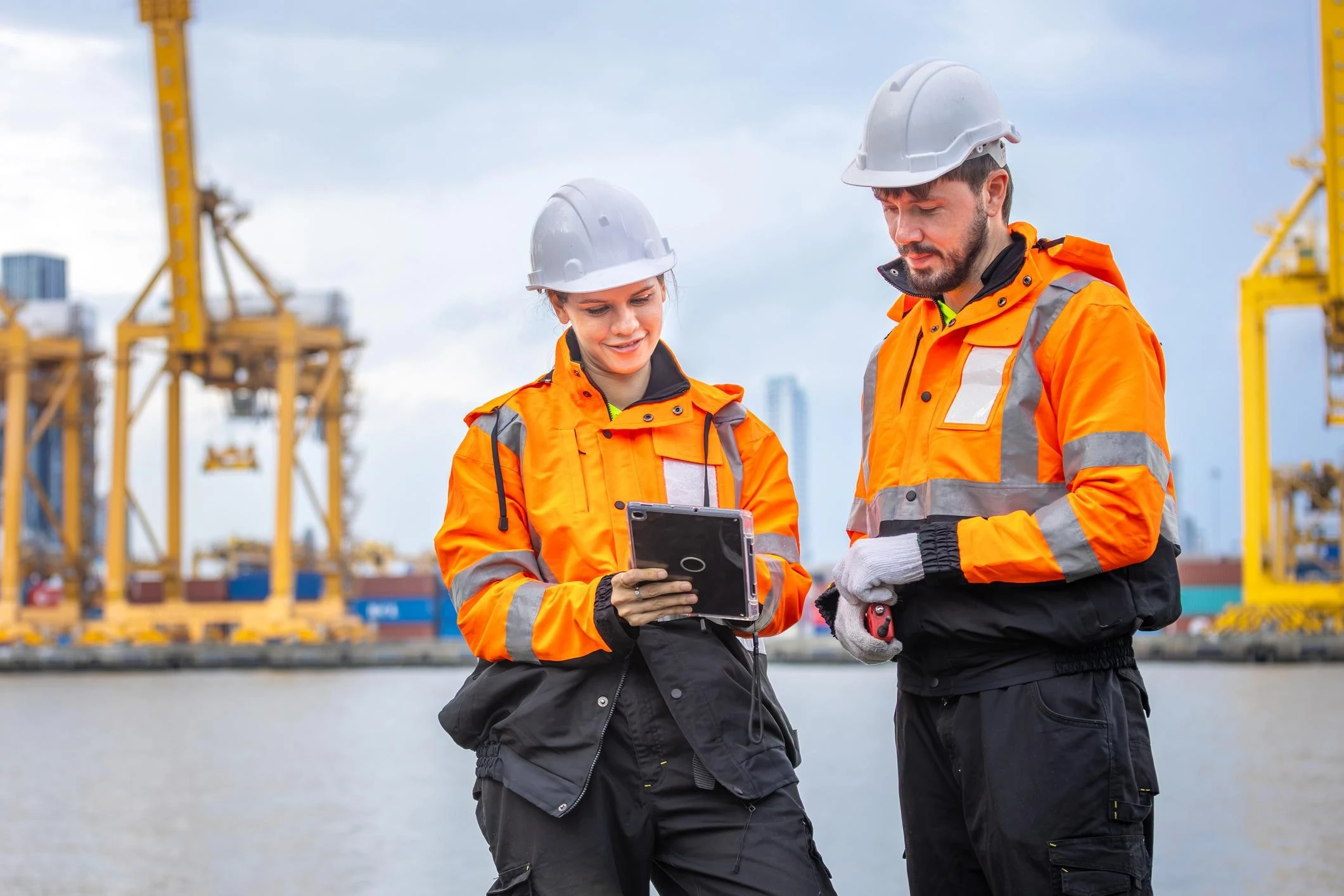
Container terminal digital twin for operational state and resource modeling

Industrial Digital Twins and Simulation Research for Port and Terminal Operations

Simulation can help port and terminal teams examine operational choices before changing live equipment, work plans, or terminal processes. Research in this area investigates how a model of vessel, quay, yard, gate, and landside activity can be aligned with physical observations, used to compare candidate decisions, and evaluated against the conditions of a specific terminal.

Contact PortOps AI

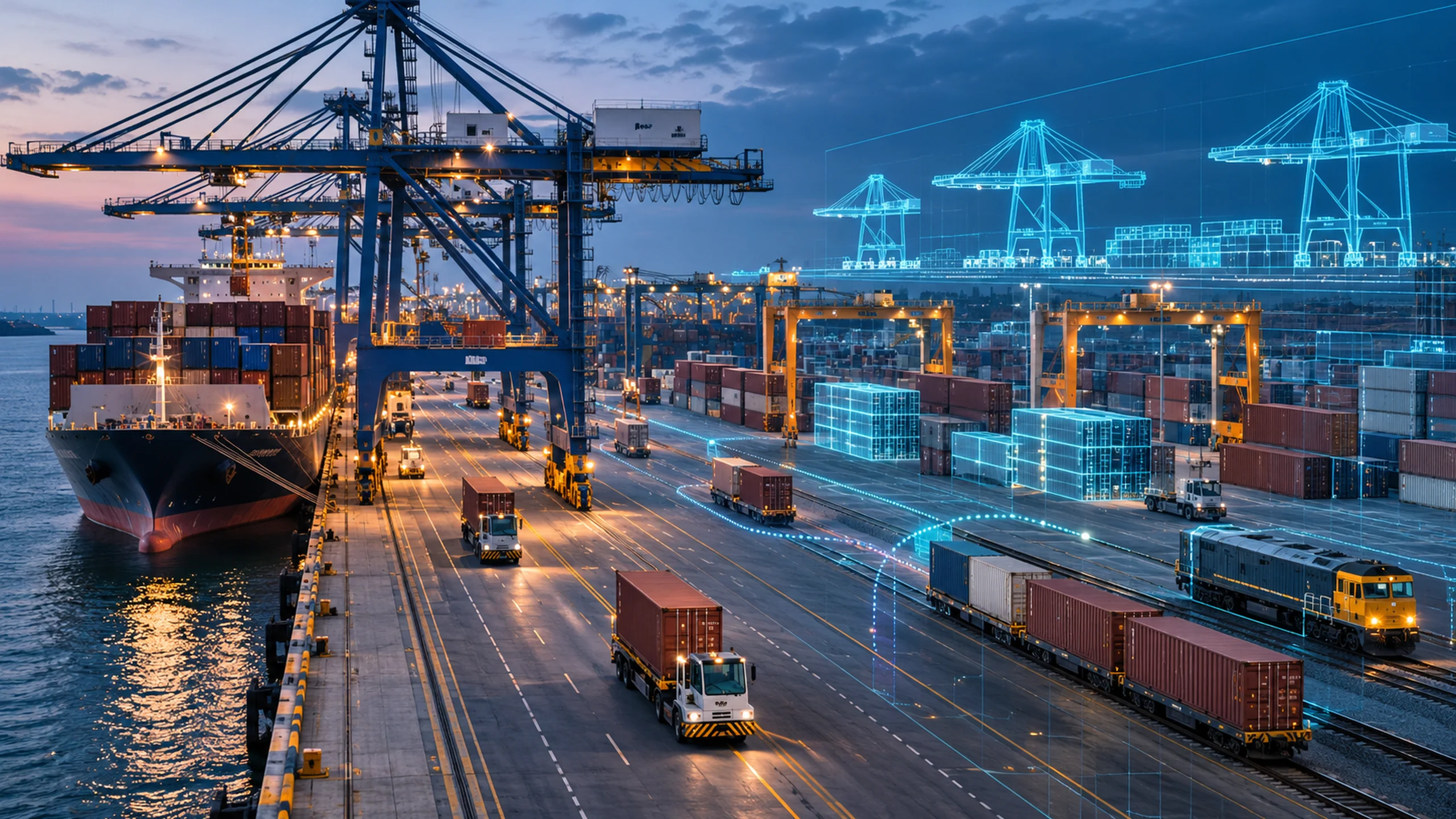
The research focus is not simply to create a three-dimensional representation of a port. A useful operational model must represent the relationships that govern terminal performance: vessel arrival and berth windows, quay crane work, container transfer, yard capacity, terminal tractor or automated guided vehicle movements, gate and rail activity, equipment availability, and the operating rules that connect these activities. Its outputs must be compared with observed events and measured outcomes before they are used to support operational decisions.

Why Digital Twin Research Matters In Port Operations

Container terminals operate as interconnected systems. A change in quay crane assignment can affect the rate of container discharge, the demand for terminal tractors, yard crane workload, storage availability, and the movement of trucks or rail traffic. A local improvement can therefore create a queue or constraint elsewhere in the terminal.

Digital twin and simulation research examines whether these dependencies can be represented well enough to help planners and operations teams understand current conditions, replay previous shifts, and compare alternative operating plans. Potential questions include whether a different equipment allocation could reduce waiting, whether a revised yard strategy could limit rehandles, or how a late vessel, unavailable crane, delayed truck arrival, or network interruption could affect the next operating window.

The distinction between a simulator and a digital twin is important. An assumption-based simulator can explore a hypothetical terminal or proposed process. A digital twin requires a defined relationship with a physical terminal, including relevant observations and a process for checking whether the model continues to represent that terminal. A visual 3D model alone does not establish this relationship.

Operational Digital Twins For State Estimation and Action Comparison

An operational digital twin may combine terminal operating system (TOS) events, equipment status, location observations, work records, and operational constraints to estimate the state of a defined terminal process. The research question is whether the model can reconstruct the operational picture with enough accuracy and timeliness to support a specific planning or control-room decision.

Relevant port workflows may include berth and vessel service planning, quay crane allocation, container transfer between quay and yard, yard block utilization, terminal tractor dispatch, automated guided vehicle routing, gate appointment flow, and rail interface coordination. The model boundary should be selected around one decision problem rather than attempting to represent every activity at the port at once.

Research questions include:

  • Which operational events and equipment states are necessary to estimate the selected process state?

  • How should the model handle delayed, missing, duplicated, or conflicting TOS and equipment observations?

  • How closely do predicted queues, equipment utilization, container moves, and service times match held-out terminal records?

  • Which candidate actions can be compared without sending commands to live terminal equipment?

  • How does model usefulness change when vessel schedules, yard conditions, equipment availability, or demand vary?

Candidate methods include discrete-event simulation for queues and resource contention, process-based models for container flow, agent-based models for interacting vehicles and operating entities, and state-estimation methods that reconcile event records with sensor or equipment observations. Hybrid approaches may be useful when the research question spans both scheduled workflows and variable equipment behavior.

Simulation-to-Reality Transfer and Synthetic Data

A model that performs well under its own assumptions may behave differently when exposed to actual terminal conditions. Simulation-to-reality research examines this gap. Port operations include variable arrival times, equipment degradation, weather-related restrictions, changing yard density, human intervention, incomplete planning information, and exceptions that may not appear in a simplified model.

Synthetic data can help create repeatable normal, rare, and degraded scenarios when operational records are limited or when a test condition is too disruptive to reproduce in a live terminal. Synthetic observations should be generated from an explicit model of the underlying operational state, then modified to represent measurement limitations such as missed location updates, delayed messages, sensor drift, timestamp mismatch, and incorrect asset association. Hidden ground truth must remain separate from the data supplied to the decision method to prevent information leakage.

Research questions include:

  • Which physical and operational assumptions have the greatest effect on model predictions?

  • How much does model performance degrade when demand, equipment behavior, or operating conditions differ from the training or calibration scenarios?

  • Can synthetic scenarios cover rare disruptions without distorting their expected frequency in ordinary operations?

  • Which real measurements are needed to calibrate or challenge the model?

  • How should uncertainty be communicated when the model is asked to predict outside the conditions it has been evaluated against?

A simulator without physical observations should be described as assumption-based and plausibility-reviewed. It should not be described as calibrated, field-validated, or a digital twin of a real terminal. Where authorized physical observations are available, model predictions should be compared with held-out measurements that were not used to tune the model.

Hardware-in-the-Loop and Degraded-Condition Testing

Hardware-in-the-loop testing can connect a simulation environment to selected physical controllers, gateways, or equipment interfaces in a controlled test arrangement. For port operations, a bounded test could examine how a crane control interface, yard equipment controller, terminal vehicle subsystem, or supervisory system responds to simulated operating states and command sequences. The test boundary must be defined so that simulation outputs cannot unintentionally operate live equipment.

A proposed demonstration should cover normal operation as well as rare and degraded conditions. Examples include a quay crane becoming unavailable during a vessel call, a terminal tractor failing to report its position, a yard block reaching a modeled capacity limit, a delayed TOS event, loss of a communications link, or a command acknowledgment that does not match the observed equipment state.

Candidate test methods include:

  • Replay of timestamped, de-identified or synthetic TOS and equipment event sequences.

  • Discrete-event simulation of vessel, crane, yard, vehicle, gate, and rail interactions.

  • Controlled interface tests using simulated controller inputs and isolated hardware or software test benches.

  • Fault injection for message delay, message loss, stale measurements, sensor drift, and partial equipment response.

  • Comparison of baseline planning rules with a candidate decision method under matched scenarios.

A hardware-in-the-loop result demonstrates behavior only within the tested configuration and conditions. It does not establish that a production installation is safe, certified, or ready for deployment. Site commissioning, equipment-vendor review, independent protective functions, and physical validation remain separate requirements.

Counterfactual Experiments For Terminal Flow and Resource Planning

Counterfactual simulation allows researchers to compare alternative operating choices against a common modeled demand and disturbance profile. For example, a study could compare alternative quay crane allocations, yard block strategies, terminal tractor dispatch policies, or vessel-to-yard coordination rules. The purpose is to understand how a change in one part of the terminal affects the rest of the modeled process.

A fair experiment should define a credible baseline before testing a candidate approach. Both methods should receive matched demand and disturbance scenarios where practical, while allowing each policy to change the subsequent simulated state. The analysis should include cases where the candidate method provides little benefit or performs worse, not only favorable runs.

Potential outputs include vessel service time, quay crane productivity, equipment utilization, vehicle queue time, container transfer time, yard rehandles, gate truck turnaround, rail interface delay, energy use, and recovery time after a disruption. Each measure needs a defined unit, denominator, time window, and aggregation method. These are candidate measures, not claims of achieved PortOps AI performance.
Industrial World Models and Prediction Of Action Consequences

An industrial world model seeks to represent how a system changes over time and how candidate actions may affect its future state. In a port setting, this could mean estimating the likely consequences of changing equipment assignments, dispatching a vehicle, reallocating a container move, or revising a work sequence. The model should expose uncertainty and identify conditions in which its predictions are unreliable.

Research should compare model-based predictions with simpler baselines, such as current planning rules, historical averages, or rule-based resource allocation. It should also test whether the model can recognize stale observations, unfamiliar operating states, and scenarios outside its evaluated range. When evidence is insufficient, the system should abstain from a recommendation or escalate the decision for human review.

Proposed Demonstration and Research Workflow

A practical first demonstration should use a bounded workflow, such as container transfer from a quay crane to a yard block, or terminal tractor dispatch within a defined operating zone. The scope should identify the equipment classes, process boundary, shifts, operating modes, demand profile, baseline workflow, candidate method, and the decisions that the model is intended to inform.

  1. Specify the operational question, process boundary, equipment, users, operating constraints, and expected decision.

  2. Create an assumptions register covering parameter names, units, values or ranges, distributions or rules, source and date, confidence, reviewer, and sensitivity importance.

  3. Define a versioned data dictionary. Typical fields may include scenario_id, run_id, timestamp_utc, asset_id, operating_mode, value, unit, quality_flag, source_type, and dataset_version.

  4. Generate the underlying operational state and separate imperfect observations, decisions, commands, and outcomes into linked records.

  5. Run baseline and candidate methods on matched normal, rare, and degraded scenarios, with independent runs and fixed seeds for reproducibility.

  6. Compare model predictions with held-out physical observations where authorized and available. Otherwise, label the exercise assumption-based and plausibility-reviewed.

  7. Record limitations, sensitivity results, model and dataset versions, code versions, random seeds, and the approval history.

The model may draw on approved TOS event histories, equipment telemetry, container and vehicle movement records, crane cycle information, gate and rail timestamps, maintenance records, and relevant environmental or operating constraints. Actual data access, field availability, retention, and interface compatibility must be confirmed with the terminal. No specific connector, data feed, or integration is implied by this research agenda.

Evaluation Measures

Evaluation should be defined before the experiment begins. The measures below are candidates and should be selected according to the modeled workflow and the decision being assessed.

  • State estimation error: difference between the estimated terminal or equipment state and the independently observed reference state.

  • Outcome prediction error: difference between predicted and observed process outcomes, with the metric and unit defined for each outcome.

  • Model mismatch: systematic difference between simulated behavior and observed terminal behavior across operating conditions.

  • Scenario coverage: proportion of predeclared normal, rare, and degraded conditions represented in the test set.

  • Simulation-to-reality transfer degradation: change in model or decision performance when evaluated against held-out physical observations or changed operating conditions.

  • Decision usefulness: whether the candidate method improves the predeclared operational objective without unacceptable constraint violations or adverse outcomes.

  • Compute cost: runtime, memory, and processing requirements for the modeled scenario and intended decision interval.

Report run counts, seeds, outcome distributions, uncertainty methods, exclusions, and sensitivity to influential assumptions. A min-to-max range should not be labeled a confidence interval. Separate model accuracy from operational benefit: a more accurate prediction does not by itself prove reduced vessel delay, improved throughput, lower energy use, or avoided cost.

Limitations and Current Research Status

Port equipment simulation and terminal operations validation

The work described on this page is a research direction and proposed evaluation approach. The source brief does not establish a completed PortOps AI digital twin, a calibrated terminal model, an executed hardware-in-the-loop demonstration, a customer deployment, or measured operational improvements. Those statuses must be updated only when supporting evidence has been reviewed and approved.

Model fidelity is limited by missing or unreliable operational data, changes in terminal procedures, human intervention, equipment variation, incomplete partner schedules, and unmodeled disruptions. Synthetic data can expand scenario coverage but cannot replace physical validation. A model calibrated to one terminal, equipment configuration, or operating period should not be assumed to transfer to another without evaluation.

Research outputs should preserve generator code, parameter files, random seeds, dataset and model versions, validation checks, raw outputs, analysis scripts, and sensitivity results. Any public study based on synthetic data must be clearly labeled as a Simulation-Based Case Study and must disclose that it does not report an actual customer deployment.

How This Research Connects To Physical AI and AIoT

The research connects physical observations with decision evaluation. The Sensing Engine provides the measurement context needed to estimate equipment and process state. The AI Decision Engine can evaluate predictions, alternatives, and recommendations. Where physical action is in scope, the Physical AI Action Engine introduces command authority, interface constraints, and outcome verification. A simulation result does not itself authorize a physical action.

Research into digital twins and simulation therefore complements, rather than replaces, work on sensing, decision quality, physical control, and system integration. The model must remain explicit about which inputs are observed, which states are inferred, which outputs are recommendations, and which outcomes have been independently verified.

Frequently Asked Questions

What is the difference between a port simulator and a digital twin?

A simulator can represent a hypothetical or proposed terminal process. A digital twin is tied to a defined physical system through relevant observations and a validation process. A 3D visualization by itself is not sufficient to establish a digital twin.

What port operations can be modeled?

A bounded study may model berth and vessel service planning, quay crane allocation, container transfer, yard block capacity, terminal tractor or automated guided vehicle dispatch, gate flow, or rail interface coordination. The selected scope should match a specific operational question.

Can synthetic data validate a port digital twin?

Synthetic data can support repeatable scenario testing and expose model behavior under controlled assumptions. It cannot independently validate a model against a real terminal. Physical observations and held-out comparisons are needed for field validation.

What is hardware-in-the-loop testing in a terminal context?

Hardware-in-the-loop testing connects a simulation to selected physical controllers, gateways, or equipment interfaces in a controlled environment. It can test interface behavior and selected fault conditions, but it does not establish production safety or deployment readiness.

Which measures should a port simulation study report?

Depending on the workflow, measures may include state and outcome prediction error, vessel service time, crane productivity, equipment utilization, queue time, yard rehandles, gate turnaround, scenario coverage, transfer degradation, decision usefulness, and compute cost. Every metric needs a defined unit and evaluation method.

Discuss A Digital Twin Or Simulation Research Question

A useful evaluation starts with a defined terminal workflow, the operational data available for that workflow, and a clear baseline for comparison. Discuss a port or terminal process, the equipment and systems involved, the candidate decision to examine, and the physical evidence required to validate the model.

Contact PortOps AI to discuss a research question
Scroll to Top