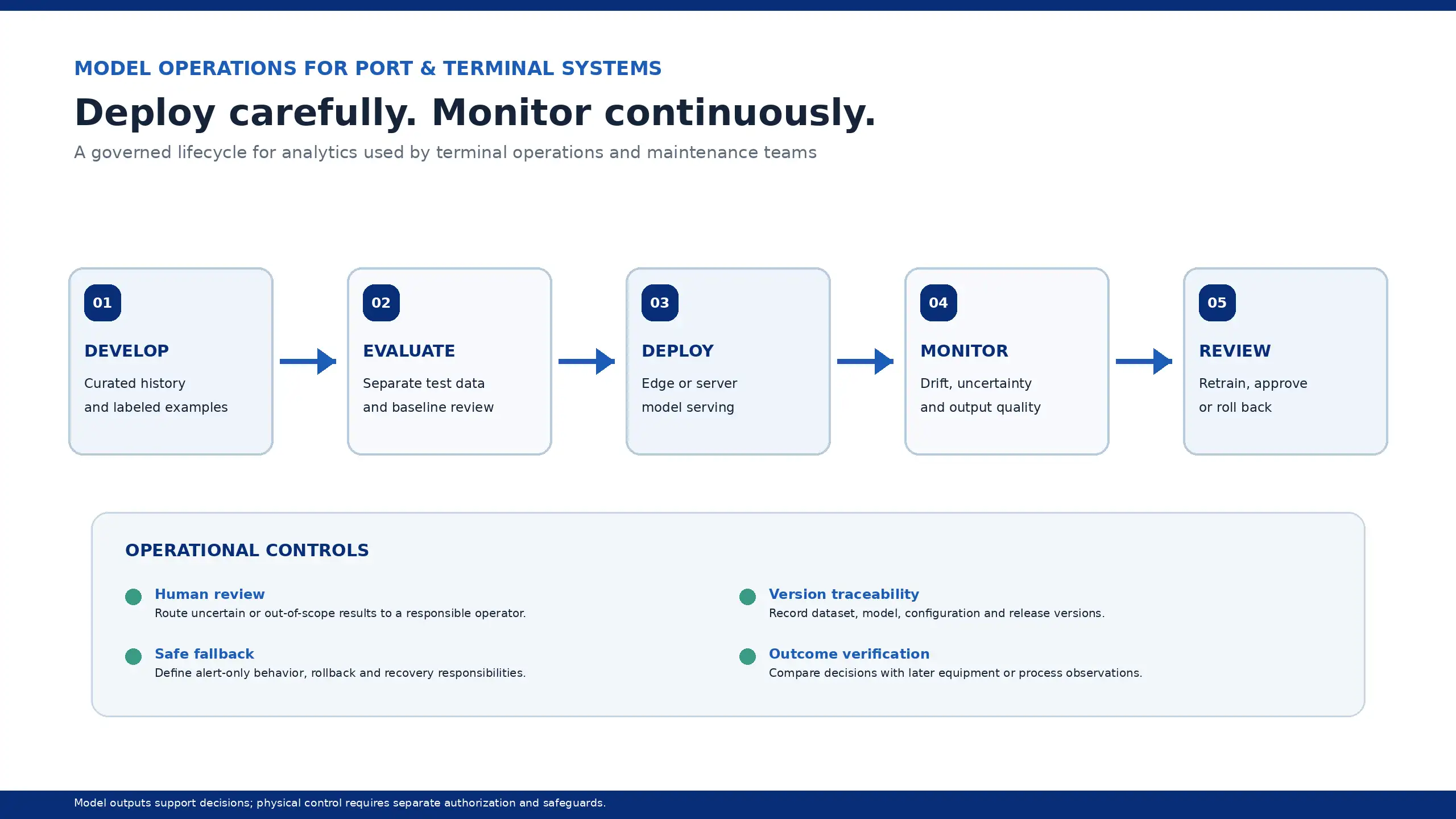
AI data and analytics workflow at a port terminal

AI Software and Analytics for Port and Terminal Operations

Artificial intelligence (AI) software can help port and terminal teams interpret equipment, cargo, and operating data. Its value depends on whether the underlying records are reliable, the analytical method fits the task, and the output reaches the right person or system at the right time. PortOps AI examines Physical AI and Artificial Intelligence of Things (AIoT) applications in the context of container terminals, cargo-handling equipment, gate activity, and connected operating workflows.

Contact PortOps AI

This page explains the software considerations behind AI-supported decisions. It covers data preparation, analytical methods, deployment, and model oversight. The aim is to help technical and operational teams define what should be evaluated before an AI function is introduced into a live terminal environment.

Build The Data Foundation Before Selecting A Model

Port operations generate information across vessel calls, berth activity, container moves, yard positions, gate transactions, and equipment use. Useful analytics depend on connecting these records to the correct asset, location, operating mode, and event time. A container movement record, for example, needs enough context to distinguish a planned move from a completed transfer. A crane condition reading needs an equipment identifier, measurement unit, timestamp, and indication of data quality.

Depending on the use case and available systems, relevant data may include:

  • Container and cargo records, including container identifiers, yard locations, interchange events, and movement history.

  • Vessel and berth activity, including arrival and departure milestones, berth assignments, and quay-crane work events.

  • Equipment information from quay cranes, rubber-tired gantry cranes, rail-mounted gantry cranes, reach stackers, terminal tractors, and other cargo-handling assets.

  • Condition measurements such as vibration, temperature, electrical values, hydraulic pressure, and equipment alarms where suitable sensors and records are available.

  • Gate and inspection information, including optical character recognition (OCR) events, inspection outcomes, exception codes, and maintenance history.

Data preparation should address missing or duplicate events, inconsistent identifiers, timestamp differences, unit conversion, sensor quality flags, and changes in operating conditions. Historical labels also need review. Maintenance records may describe a repair without confirming the exact failure mode, while inspection labels may vary between reviewers. These limitations affect what a model can reasonably learn.

Maintain dataset lineage so that each development and evaluation dataset can be traced to its source, time range, transformation rules, and version. Keep development data separate from evaluation data. Prevent information leakage by ensuring that future movements, later repair outcomes, or hidden fault labels are not included among the model inputs. Split data by time, asset, or operating condition when that better reflects how the system will be used.
Select Analytical Methods For A Defined Operating Task

The appropriate software function depends on the decision a terminal team needs to support. A method should have a defined input, output, uncertainty range, evaluation approach, and responsible user. A model should not be selected simply because a particular technique is available.

Anomaly detection

Anomaly detection can identify observations or patterns that differ from an established baseline. In a terminal setting, a candidate use may involve unusual crane vibration, an unexpected change in motor temperature, or an abnormal sequence in equipment operating data. An alert indicates that a record needs attention; it does not, by itself, establish a confirmed fault or its cause. Evaluation should include detection delay, false alerts per operating hour, missed events, and the workload created for maintenance personnel.

Prediction and forecasting

Forecasting methods can estimate future values or operating conditions from historical and current information. Potential port applications include forecasting gate arrival patterns, equipment demand, yard activity, or condition trends. The forecast horizon, update frequency, operating constraints, and acceptable error should be defined before testing. Failure-risk estimation and remaining-useful-life prediction require suitable failure histories and validated outcome labels. Where those records are incomplete, the page should describe the function more narrowly.

Computer vision analysis

Vision models can assess images or video from selected inspection points. Depending on the task, this may include container identification support, visible damage review, seal or component presence checks, or equipment-area inspection. Lighting, weather, camera angle, occlusion, image quality, and variation among container types can affect results. Test datasets should represent the actual capture conditions and relevant defect classes. Report false accepts and false rejects, not only overall accuracy.

Optimization and decision support

Optimization methods can compare resource assignments or operating alternatives against defined objectives and constraints. Potential questions include how to prioritize equipment inspections, allocate available resources, or assess alternative responses to changing yard conditions. A recommendation should expose the assumptions and constraints that shaped it. Distinguish a dashboard insight or workflow request from a command that controls equipment.

For each selected function, compare the candidate method with a credible baseline, such as an existing threshold, rule, forecast, or planning procedure. Include routine operating conditions and difficult cases. Review performance across shifts, equipment types, workload levels, and data-quality conditions rather than relying on a single aggregate score.

Choose An Edge Or Server Deployment Model

Model serving can take place on an edge computer near the equipment or data source, on a customer-managed server, or in a cloud environment. The right arrangement depends on response time, network availability, data governance, computing requirements, maintenance access, and the systems that must receive the output. These are deployment options to assess, not a statement that every option or infrastructure arrangement is currently offered.

Edge processing may be relevant when a use case needs local inference or must continue through intermittent connectivity. Server-based processing may suit workloads that combine information from multiple terminal systems or require centralized model management. A hybrid design may be considered where local processing and centralized reporting have different requirements. Document the data path, expected latency, buffering behavior, and what happens when a connection or service is unavailable.

Every deployed model should have a controlled release process. Record the model version, dataset version, configuration, deployment location, release date, and responsible owner. Define how an updated model is tested, approved, deployed, and rolled back. Integration outputs may include alerts, scores, forecasts, recommendations, or structured events. The receiving application and its interface must be identified and tested before any compatibility claim is made.

For related implementation details, see the IoT Software page for device and event processing and the System Integration and Deployment page for enterprise interfaces and deployment responsibilities.

Monitor Model Behavior and Operational Suitability

Model performance can change as equipment ages, operating practices shift, sensors are replaced, camera conditions vary, or terminal demand changes. Monitoring should therefore cover both technical behavior and operational usefulness. Review input-data quality, missing-value rates, feature distributions, alert volumes, prediction error, and confirmed outcomes. Where labels arrive later, define how and when results will be checked against inspections, maintenance findings, or completed operating events.

Drift monitoring can identify changes in input data or model behavior, but a drift signal does not automatically mean that retraining is the correct response. A responsible technical owner should investigate the cause, determine whether the new conditions are represented in evaluation data, and decide whether to retain, adjust, retrain, or withdraw the model. Keep a record of the decision and the model version affected.

When observations are stale, incomplete, outside the evaluated conditions, or too uncertain for the intended task, the software should be able to flag the limitation and abstain from producing a confident recommendation. Escalation to an operator or analyst may be more appropriate than forcing a result. Define alert ownership, review expectations, and the conditions that return the workflow to its normal process.

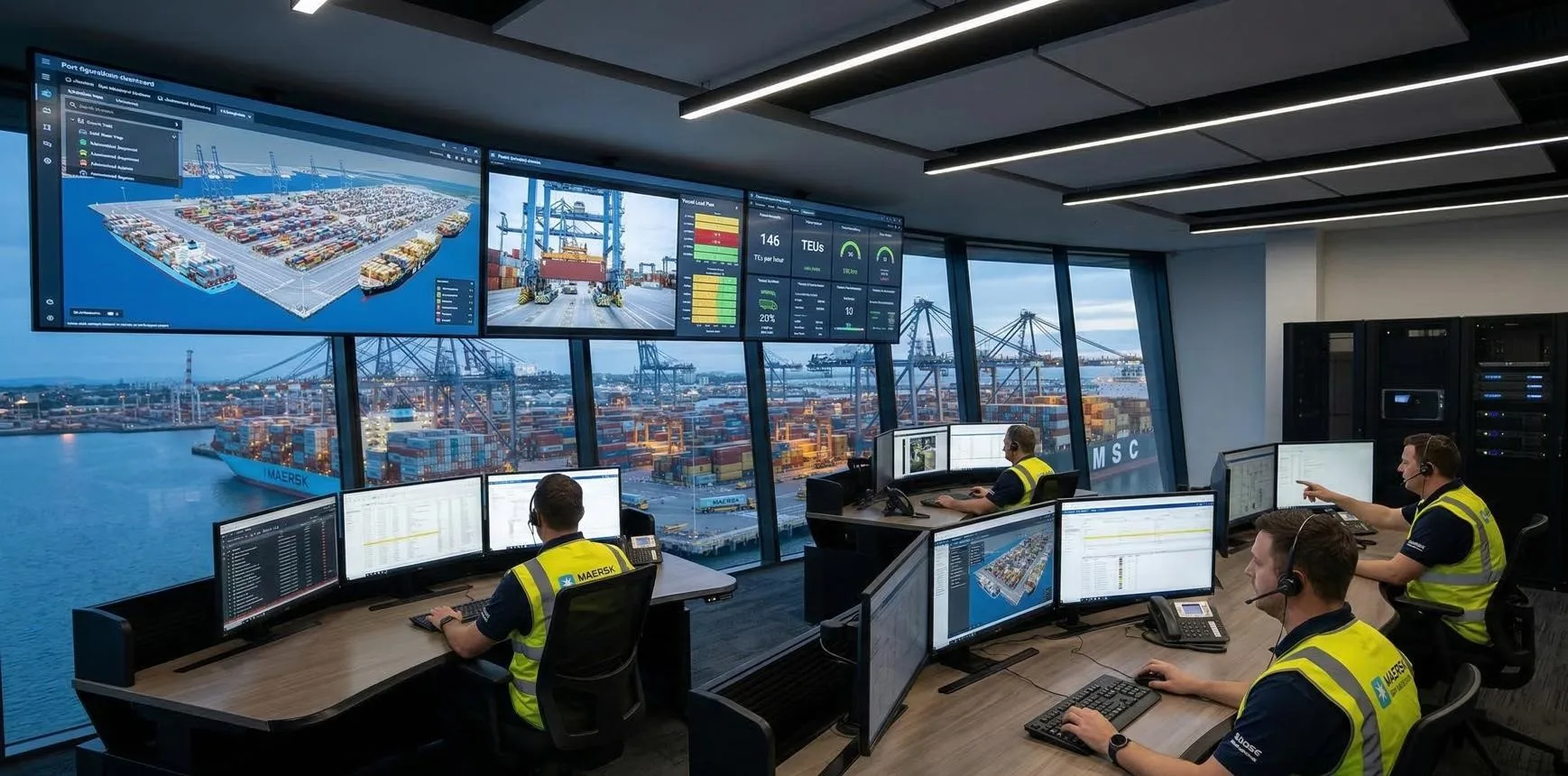
Port terminal AI model deployment and monitoring

Evaluate Before Expanding An AI Workflow

A practical evaluation should begin with a bounded operational question, an agreed baseline, and measurable acceptance criteria. Involve the people who own the process, including terminal operations supervisors, equipment engineers, maintenance planners, IT teams, and system integrators as appropriate. Confirm what data can be accessed, who is authorized to use it, and whether the records are representative of the operating conditions in scope.

  1. Define the target asset, process, location, operating shifts, and decision that the software is expected to support.

  2. Document source systems, data owners, identifiers, timestamp conventions, units, sampling intervals, missing-data rules, and retention constraints.

  3. Prepare representative development and evaluation datasets, with documented labels, lineage, exclusions, and leakage controls.

  4. Compare the candidate method with a credible rules-based or existing operational baseline.

  5. Measure task-specific performance, including false alerts, missed events, prediction error, review workload, and performance by operating condition.

  6. Test degraded conditions such as delayed messages, sensor drift, missing observations, connectivity loss, and changes in workload.

  7. Record limitations, responsible reviewers, release approval, rollback conditions, and the evidence needed before a wider deployment.

A pilot should also establish how users respond to outputs and whether the recommended action is feasible within terminal procedures. An algorithm that performs well on a prepared dataset may still be unsuitable if the alert arrives too late, the receiving team cannot act on it, or the required integration is unavailable.

Implementation Status and Evidence

The technology brief defines the software functions and evaluation requirements to be addressed. It does not establish that a specific algorithm, connector, model-serving environment, or production deployment is already operating at a customer terminal. Any public description of a demonstrated function should identify what actually runs, where it runs, the data used, the test conditions, and the measured results. Work that remains at the design stage should be labeled as proposed.

Do not present synthetic-data analysis as a customer result or field validation. Where a simulation is used, identify the synthetic data, assumptions, run scope, and limitations. Production claims require appropriate site-specific evidence and review.

How This Fits With The Wider Technology Architecture

AI software and analytics implement selected decision functions. They depend on identification and sensing inputs, and they may exchange results with IoT software, enterprise applications, or authorized action workflows. The AI Decision Engine page explains the functional role of analysis and decision outputs. This page focuses on the software and model lifecycle needed to implement and evaluate those functions.

Discuss An AI Software Application

Start with the operating task, the equipment or process involved, and the information available to support it. PortOps AI can use that discussion to identify the data preparation, analytical method, deployment constraints, integration dependencies, and evaluation evidence that should be considered.

Discuss your application with PortOps AI
Scroll to Top