Asset and People Tracking and Traceability for Port & Terminal Operations

Port and terminal operations depend on accurate information about where containers, cargo-handling assets, and authorized personnel are located as work moves across gates, yards, vessel aprons, and interchange points. When physical handoffs are recorded late, duplicated, or associated with the wrong identifier, terminal teams can spend time reconciling inventory, investigating exceptions, and confirming who or what entered a controlled area.

Contact PortOps AI

Track Containers and Equipment Across Terminal Handoffs

A container’s operational history can span vessel discharge, quay-side transfer, yard placement, rehandles, gate interchange, and outbound loading. Each handoff creates an opportunity to associate a physical movement with the correct container identity, time, location, and responsible workflow. Similar records can support the movement of chassis, terminal tractors, spreaders, and other mobile equipment when those assets are within the approved tracking scope.

PortOps AI focuses on Physical AI and Artificial Intelligence of Things (AIoT) for port and terminal workflows. Asset traceability and personnel visibility serve related but different purposes. Container and equipment tracking supports operational records and custody workflows. Personnel-location information should be collected only for defined needs, such as controlled-area access or emergency accountability, with appropriate privacy and access controls.

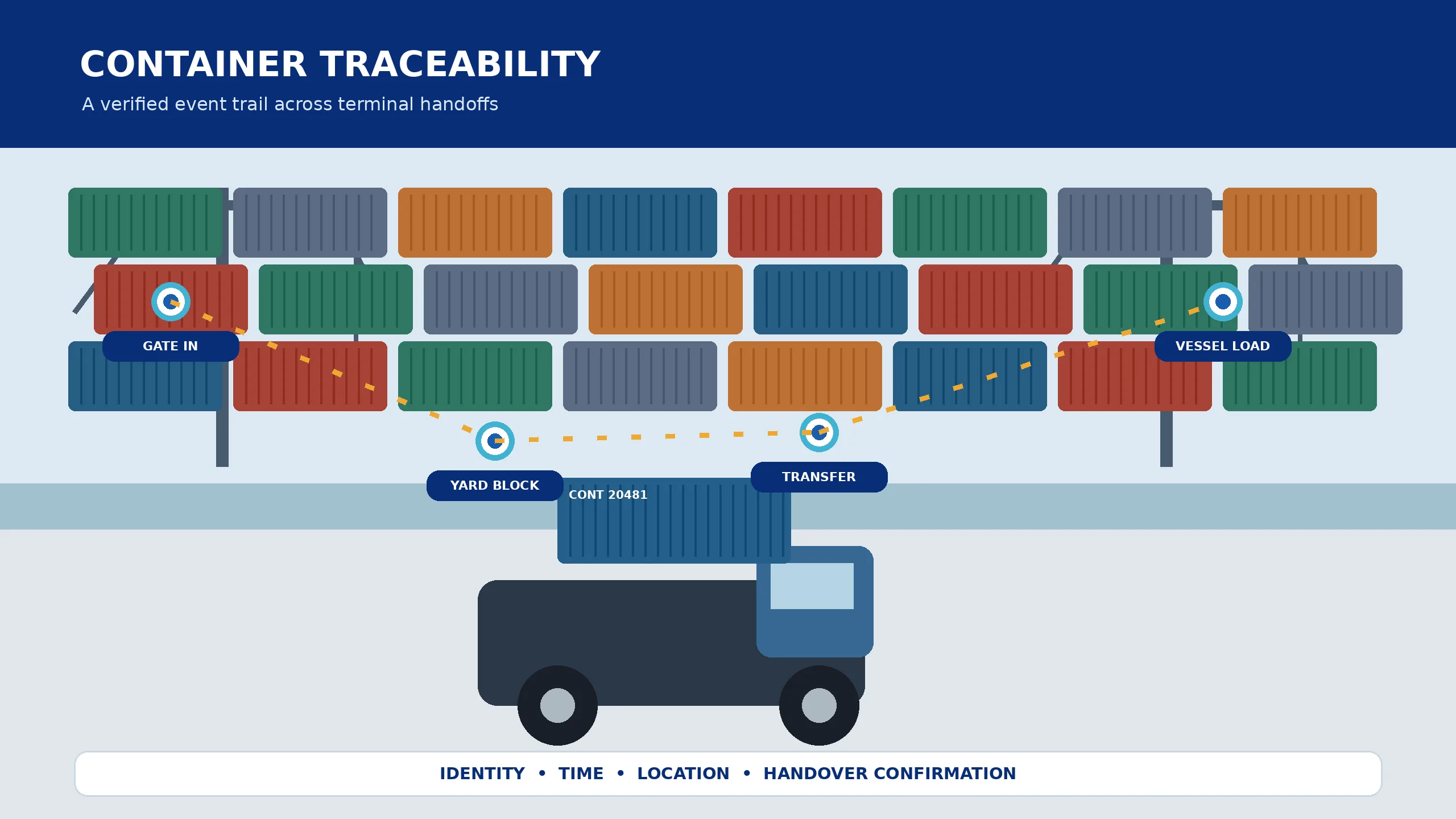
A traceability workflow can connect observations from gate lanes, container handling areas, yard blocks, interchange points, and vessel operations. For example, a gate event may establish that a container entered the terminal. A yard-zone observation can support its placement record, while a subsequent equipment or operator confirmation can document a transfer to another block or loading area. The receiving event should be checked against the expected move and associated terminal record rather than treated as confirmed solely because a tag or camera was detected.

The operating model should define the asset classes, location zones, event points, operating hours, and business records that matter. A useful event record may include the container or equipment identifier, event time, observation time, source device, location zone, event type, quality flag, and associated work or interchange reference. These fields help distinguish when a physical event occurred from when a system received its observation.

Design Identification Around the Terminal Environment

No single identification method fits every port environment. Selection depends on the required location granularity, asset type, mounting options, traffic flow, metal structures, stacked containers, weather exposure, line of sight, power availability, and maintenance access.

RFID for Defined Read Points and Asset Identification

Radio-frequency identification (RFID) can support identification at defined gate lanes, transfer points, equipment areas, or controlled passages when tags and readers are selected for the environment. Read zones must be engineered to limit unintended reads from adjacent lanes or nearby stacked assets. Tag placement, reader configuration, interference, and movement speed should be tested with representative container and equipment configurations.

BLE and UWB for Location Context

Bluetooth Low Energy (BLE) can provide proximity or zone-level location context when beacon placement and radio conditions are suitable. Ultra-wideband (UWB) can be evaluated where a workflow requires more precise ranging within a defined operating area and the infrastructure can be installed and maintained. Both approaches require site surveys and validation around steel structures, moving equipment, multipath conditions, and changing yard layouts.

Vision for Container Codes and Operational Context

Fixed or mobile cameras can capture container markings, vehicle identifiers, and movement context at selected checkpoints. Optical character recognition (OCR) may assist with reading container codes, but image quality, occlusion, lighting, dirt, weather, viewing angle, and code condition affect results. Vision observations should be checked against valid identifier formats and relevant terminal records before being used to resolve an operational event.

A practical design may combine technologies at different points. A gate camera can capture a container code, an RFID reader can detect a tagged asset at a controlled transfer point, and a BLE or UWB system can provide zone context where justified. These are design options, not a statement that PortOps AI currently supports every device, protocol, or integration. Hardware and interface compatibility must be confirmed during requirements assessment.

Container terminal handoff route showing gate entry, yard block, transfer, and vessel loading checkpoints.

Turn Observations into Reliable Movement Events

Identification hardware produces observations, not automatically verified business events. Event processing should account for missed reads, repeated detections, delayed messages, clock differences, stale observations, and incorrect associations. A container detected near a yard block, for example, may not have completed the expected transfer if the observation came from an adjacent lane or was received after a later movement.

An event-processing workflow can apply time windows, location rules, identifier validation, duplicate suppression, and sequence checks. Conflicting observations should remain visible for review rather than being silently forced into a single location. When a required observation is missing, the system can flag the transfer for reconciliation using an approved source such as an operator confirmation, equipment transaction, gate record, or terminal operating system entry.

Time handling is especially important when devices buffer data during network interruptions. Store the event time reported by the source separately from the ingestion time recorded by the receiving service. Define the terminal’s time zone, clock synchronization approach, event ordering rules, and behavior for delayed or out-of-order messages. Maintain a traceable record of corrections so users can distinguish an original observation from a reviewed resolution.

Connect Traceability with Terminal Workflows

A useful tracking record should support a specific operational task. Depending on the terminal’s systems and approved interfaces, relevant destinations may include a terminal operating system (TOS), gate-management application, equipment-dispatch workflow, inventory or interchange record, access-control system, or safety process. Integration design should define the system of record, identifier mapping, event ownership, update frequency, rejected-record handling, and recovery after an outage.

For a container handoff, the workflow may compare the observed container ID, source zone, destination zone, move reference, and receiving confirmation. Exceptions can be routed to the responsible yard planner, gate operator, equipment coordinator, or inventory-control team. The system should preserve enough context for the reviewer to understand why the event was flagged and what evidence was used to close it.

The integration scope should be confirmed for each facility. Existing APIs, message brokers, database exports, equipment interfaces, and vendor restrictions vary by terminal. A proposed connection should not be presented as an available connector until its technical and operational status has been verified.

Use Personnel Location Data for Defined Operational Purposes

Personnel visibility is a separate design decision from container traceability. A terminal may consider identity and location records for site entry, restricted-area access, contractor accountability, or emergency mustering. The purpose should determine the level of location detail. Access control may require a record that a credential passed a gate, while an emergency workflow may need to know whether a person was last observed within a defined muster or operating zone.

Personnel systems should use approved credentials and clearly defined location zones. RFID badges, BLE devices, UWB tags, or other methods may be assessed according to the task, coverage requirements, wearability, battery maintenance, radio conditions, and site policy. A badge read at an entrance proves only that the credential was observed at that point and time. It does not prove the person remained in the area or is currently safe.

Emergency mustering requires particular care. Location observations can help safety personnel identify last-known zones and prioritize checks, but they do not guarantee that every worker or contractor has been accounted for. The process must retain established alarm, evacuation, roll-call, and human verification procedures. Any automated status should show its timestamp and confidence or quality state, and should not replace an authorized safety decision.

Personnel data governance should define the permitted purpose, data fields, user roles, retention period, access logging, and process for correcting inaccurate records. Restrict detailed location histories to personnel with a legitimate operational need. Explain the policy to employees and contractors, follow applicable labor, privacy, and safety requirements, and avoid collecting continuous location data when a gate event or zone-level record is sufficient.

Evaluate the Workflow with Measurable Pilot Criteria

A pilot should test the selected workflow under representative terminal conditions before broader deployment. Define a baseline process, a limited asset or personnel scope, observation points, operating shifts, expected event volumes, and the records that will serve as the reference. Include normal traffic as well as busy periods, blocked reads, equipment movement, temporary network loss, and changes to yard configuration.

Event Completeness

Measure the share of required ground-truth events that were correctly captured and associated with the intended asset or person. Define which events are required, how the reference record is established, and how partial or late observations are counted.

False-Event and Association Rate

Measure false events, duplicate events that remain after processing, and incorrect associations between identifiers and locations. Report the denominator and group repeated alerts consistently. Review performance by lane, zone, equipment type, weather condition, and operating period where the sample supports it.

Reconciliation Time and User Effort

Compare the time required to resolve missing or conflicting movements with the existing manual process. Record the number of exceptions requiring operator review, the roles involved, and the effort needed to maintain readers, tags, anchors, cameras, and associated data services.

Data and Integration Reliability

Test timestamp consistency, delayed-message recovery, duplicate handling, identifier mapping, interface availability, and audit history. Verify that users can trace a displayed status back to its source observation and any subsequent manual correction.

Set acceptance criteria before testing and report unfavorable cases as well as successful ones. A pilot should establish whether the selected hardware covers the intended observation points, whether the event logic reflects actual terminal movement, whether users can resolve exceptions, and whether the integration fits the facility’s operating procedures. Do not infer guaranteed productivity gains or emergency-response outcomes from a limited test.

Plan a Port-Specific Tracking Assessment

PortOps AI can help frame a Physical AI and AIoT assessment around a defined terminal workflow, the assets or personnel involved, the required observation points, and the systems that must receive the resulting records. The first step is to agree on the operational question and evidence needed to evaluate it.

Discuss your asset or personnel tracking requirements with PortOps AI.

Contact PortOps AI
Scroll to Top