
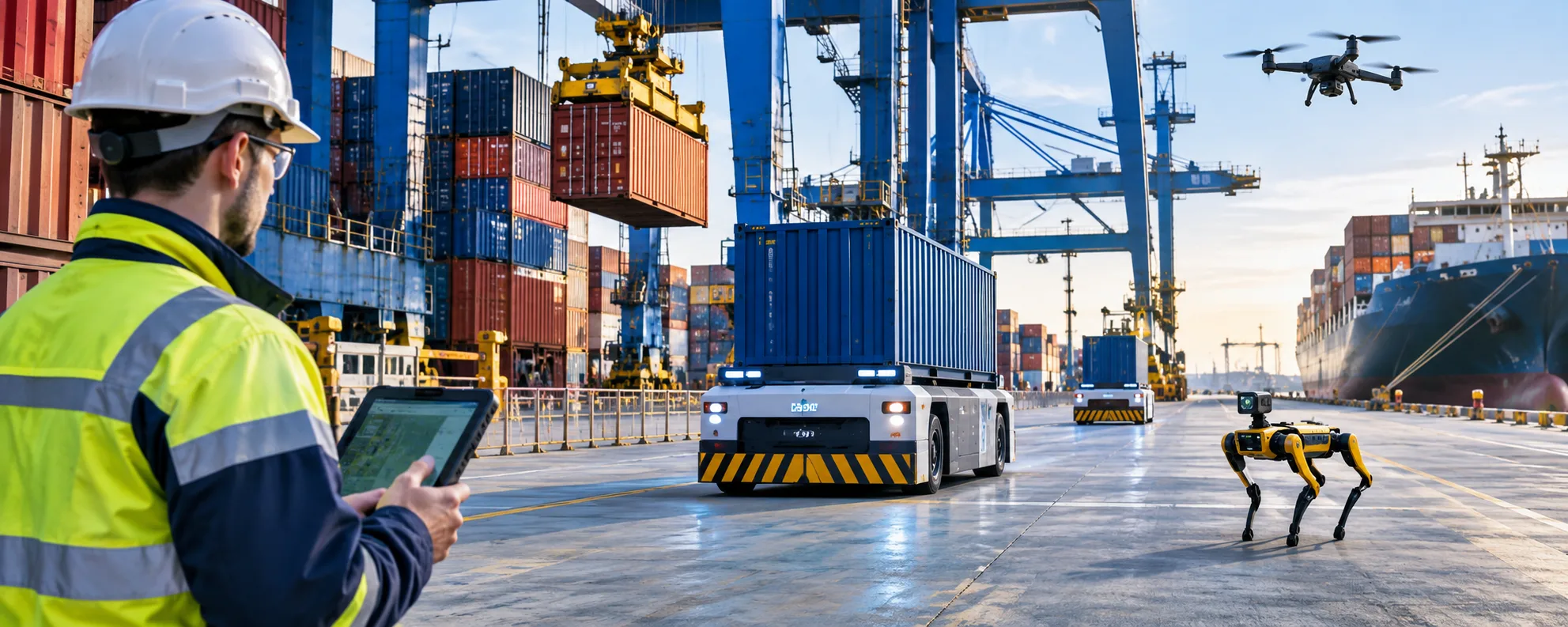
Distributed Intelligence, Robotics, Drones and Autonomous Vehicles Research for Port Operations
Port and terminal operations depend on the coordinated movement of containers, cargo, vehicles, and handling equipment across large, constantly changing environments. Robotics, drones, and autonomous industrial vehicles offer opportunities to improve how terminals inspect infrastructure, transfer materials, monitor operating conditions, and coordinate physical tasks.
Contact PortOps AIPortOps AI explores how Physical AI and Artificial Intelligence of Things (AIoT) technologies can connect machine perception, operational intelligence, and controlled physical execution. The research focus is on practical port workflows, including container yard movement, equipment inspection, autonomous material handling, and coordination between human operators and automated systems.
The objective is to investigate how distributed intelligence can support reliable decisions across connected machines while maintaining operational boundaries, human oversight, and independently verified outcomes.
Research Priorities for Robotics and Autonomous Port Operations
Port terminals present challenges that differ from conventional warehouse automation. Equipment operates across large outdoor areas, container stacks create visibility restrictions, traffic patterns change throughout the day, and multiple types of manually operated and automated vehicles share the same working environment.
Research must account for these conditions when evaluating autonomous systems.
Distributed Edge Intelligence for Terminal Equipment
Autonomous systems cannot always depend on continuous communication with a central server or cloud service. Port equipment may operate in areas with variable wireless coverage, network congestion, or temporary connectivity interruptions.
Research examines how processing and decision tasks can be distributed between onboard computers, sensor gateways, local edge servers, and central infrastructure.
Key research questions include:
Which navigation, obstacle detection, and safety-related functions should remain available locally?
How should mobile platforms respond when communication with the central dispatch system is interrupted?
How can delayed operational events be reconciled without acting on outdated vehicle or equipment states?
How should computing resources be allocated when multiple autonomous platforms request processing capacity?
Candidate methods include edge inference, model compression, event-driven communication, local state estimation, and recovery mechanisms for interrupted data exchange.
Evaluation should consider processing latency, communication bandwidth, energy consumption, retained functionality during outages, stale-command rejection, and recovery time.
Multi-Agent Coordination Across Port Equipment
A container terminal may involve yard tractors, automated guided vehicles, mobile inspection robots, drones, reach stackers, and other handling equipment. Coordinating these systems requires more than independent route planning.
Research examines multi-agent scheduling and coordination, where individual platforms receive tasks while respecting shared operating resources and terminal constraints.
Relevant research questions include:
How should autonomous vehicles coordinate container transfer assignments?
How can conflicting movement requests be resolved at shared intersections and transfer zones?
How should inspection and maintenance tasks be prioritized alongside cargo movement?
How can a terminal reassign tasks when one autonomous platform becomes unavailable?
Candidate methods include centralized scheduling, distributed task negotiation, shared resource reservation, conflict resolution, and bounded task reassignment.
Evaluation measures include task completion, fleet throughput, resource utilization, traffic conflicts, duplicated assignments, communication overhead, and recovery following platform failure.
Robotic Container and Material Handling
Material movement is a central part of port operations. Research can examine how autonomous mobile platforms and robotic handling systems support selected transfer workflows between container storage areas, inspection locations, staging zones, and designated loading or unloading points.
The technical challenge is ensuring that the correct load is identified, picked up, transported, and delivered to the intended destination.
Research questions include:
How should an autonomous mobile robot respond when load identity is uncertain?
How can changing container destinations affect task assignment and route planning?
What evidence confirms that a material transfer has been completed?
How should the system recover from blocked routes, failed pickups, or incomplete handovers?
Candidate methods include RFID and Ultra-Wideband (UWB) identification context, machine vision, robotic perception, task planning, and transfer verification.
Evaluation should include delivery accuracy, transfer completion, travel distance, throughput, congestion, operator interventions, and failed handover recovery.
Mobile Robotic Inspection of Port Infrastructure
Port infrastructure and handling equipment require regular inspection to identify visible damage, abnormal conditions, and maintenance requirements.
Mobile robots can potentially support inspection activities in locations where repeated observation, restricted access, or large inspection areas make manual data collection difficult.
Research examines:
Mobile inspection routes around container handling equipment and terminal infrastructure.
Active survey planning based on incomplete observations and changing inspection priorities.
Localization accuracy when equipment, containers, and other objects obstruct sensor visibility.
Repeated inspection of cranes, structural components, and designated equipment areas.
Integration of inspection observations with asset identification and maintenance records.
Candidate methods include visual perception, depth sensing, localization, mapping, route optimization, and uncertainty-guided inspection revisits.
A critical research distinction is the separation of navigation performance from inspection quality. A robot may successfully reach an inspection location without collecting sufficient evidence to identify a defect.
Evaluation should therefore include inspection coverage, missed regions, localization error, image suitability, defect evidence quality, mission duration, energy consumption, and operator interventions.
Drone Perception and Adaptive Aerial Inspection
Drones offer another potential approach to inspecting port infrastructure, container handling equipment, elevated structures, and designated terminal areas.
Research can investigate how aerial platforms select observation points, maintain localization, avoid obstacles, and adapt inspection missions when environmental conditions change.
Relevant research questions include:
How can a drone detect localization drift before its planned route becomes unreliable?
When should an uncertain observation trigger another inspection pass?
How should mission planning account for battery reserves, weather, visibility, and restricted operating zones?
How can aerial observations be associated with the correct terminal asset and maintenance record?
Candidate methods include camera-based perception, depth sensing, inertial measurement, positioning systems, obstacle detection, adaptive mission planning, and image-based asset inspection.
Proposed demonstrations could compare fixed inspection routes with adaptive routes that prioritize uncertain observations around a mock terminal asset or validated digital environment.
Evaluation should measure localization error, obstacle detection coverage, route deviation, inspection coverage, image suitability, mission duration, energy reserves, and successful mission termination.
Drone navigation and inspection quality must be evaluated separately. A completed flight does not establish that an asset was inspected adequately or that a defect was correctly identified.
Human-Robot Collaboration in Shared Terminal Workspaces
Port terminals require coordination between people, vehicles, and heavy handling equipment. Autonomous platforms must therefore account for human movement, changing work zones, vehicle visibility restrictions, and unexpected operational activity.
Research examines how robotic systems can recognize shared workspace conditions and adapt their movement or task execution without removing human authority.
Relevant investigation areas include:
Human movement and occupancy detection in shared terminal lanes.
Coordination between mobile robots and manually operated terminal vehicles.
Safe task handovers between operators and robotic equipment.
Communication of intended movement and operational status.
Human intervention when an autonomous platform encounters an uncertain situation.
Recovery following unexpected movement, blocked routes, or interrupted tasks.
Candidate approaches include vision-based human detection, uncertainty-aware route planning, shared workspace monitoring, controlled handover procedures, and operator override mechanisms.
Evaluation should consider task completion, separation-margin violations, near-conflict events, interruption response, operator workload, and recovery after unexpected human movement.
Independent protective functions and emergency stops must remain separate from experimental AI behavior. Research demonstrations do not establish that an autonomous system is certified or safe for unrestricted terminal deployment.
Autonomous Industrial Vehicle Perception and Motion Planning
Autonomous yard tractors and industrial transport vehicles must navigate complex terminal environments while accounting for cargo loads, equipment movement, traffic, and changing road conditions.
Research focuses on how autonomous vehicles interpret their surroundings and make movement decisions within defined operating limits.
Key areas include:
Vehicle localization and position estimation.
Obstacle detection around containers, cranes, and terminal vehicles.
Traversability assessment and route planning.
Load-dependent stopping distance and motion constraints.
Detection of occluded intersections and restricted movement areas.
Coordination with manually operated vehicles and other autonomous platforms.
Controlled stopping, fallback behavior, and requests for operator intervention.
Candidate methods include camera and depth-based perception, positioning and inertial sensing, trajectory planning, motion control, and uncertainty-aware navigation.
Proposed evaluation can begin with vehicle simulation, followed by a scaled platform or controlled test environment where appropriate.
Measurements should include localization and tracking error, obstacle detection misses, stopping margin, route completion, motion constraint violations, and appropriate human intervention requests.
Coordinating Mixed Fleets of Robots, Drones, and Autonomous Vehicles
A port terminal may eventually use multiple autonomous platforms for different operational purposes. A mobile robot could transport equipment, a drone could conduct an inspection mission, and an autonomous yard vehicle could handle a designated container transfer.
Coordinating these systems introduces challenges involving task priorities, shared infrastructure, communication, charging, and resource availability.
Research questions include:
How should tasks be allocated across platforms with different capabilities?
How can vehicle routes and inspection missions share terminal resources?
How should a fleet respond when a robot, drone, or autonomous vehicle becomes unavailable?
How can shared maps and task states remain consistent when communications are delayed?
How can inspection and material transfer handovers be verified?
Candidate methods include fleet-level scheduling, distributed task allocation, shared resource reservation, mission reassignment, and local autonomy during communication interruptions.
Evaluation measures include fleet throughput, task duplication, deadlocks, charging availability, missed handovers, communication overhead, and recovery from platform failure.
Fleet-level scheduling must remain separate from each platform's local navigation and protective controls.
Proposed Research Demonstration and Evaluation
A practical starting point is a simulated container terminal workflow involving an autonomous mobile platform transferring identified material between designated operational stations.
The demonstration can model:
An operational request identifies the material and its intended destination.
The platform receives a transfer assignment.
Identification and onboard perception establish the load and surrounding operating conditions.
The navigation system selects a feasible route.
The platform responds to blocked aisles, conflicting traffic, or uncertain observations.
The material is transferred at the designated destination.
An independent observation confirms whether the intended transfer was completed.
Exceptions are recorded for operator review and recovery.
The initial study should compare a fixed routing and scheduling policy with an adaptive candidate policy under matched operating scenarios.
| Evaluation area | Proposed measurement |
|---|---|
| Task performance | Completed and failed transfer assignments |
| Transfer accuracy | Correct material delivered to the intended destination |
| Navigation | Localization error and route deviation |
| Efficiency | Travel distance, task duration, and throughput |
| Resource usage | Energy consumption and charging availability |
| Operational constraints | Route conflicts and motion constraint violations |
| Human oversight | Operator interventions and rejected assignments |
| Recovery | Response to blocked routes and platform failures |
The evaluation should include normal operations and deliberately degraded scenarios, such as missing identification events, delayed messages, network outages, unavailable platforms, and failed material handovers.
Simulation results must be distinguished from controlled hardware demonstrations and actual terminal operating results. Any reported numerical findings must come from reproducible calculations using documented assumptions and saved evaluation outputs.
Research Scope, Limitations, and Development Status
Robotics and autonomous systems cover several distinct engineering disciplines. Their relevance depends on the equipment, operating environment, interfaces, and tasks selected for a particular port application.
The initial research scope prioritizes:
Autonomous container and material transfer.
Mobile robotic inspection of terminal assets.
Drone-based infrastructure inspection.
Autonomous yard vehicle navigation and motion planning.
Distributed edge intelligence and mixed-fleet coordination.
Human supervision and shared workspace operation.
Robotic assembly and machine-tool assistance are not initial priorities because they have a less direct relationship to the core container movement and terminal logistics workflows addressed by this page. They may be reconsidered if a specific port maintenance or equipment-servicing application establishes a clear need.
Robot learning and adaptive manipulation are supporting research topics where they can improve a defined handling or inspection task. They should not be presented as unrestricted general-purpose autonomy.
The research program is informed by the shared work of Aperture Physical AI Research Labs, Aperture Venture Studio, GAO RFID Inc., and GAO Tek Inc. This shared research direction does not establish that every topic has been implemented specifically by PortOps AI.
Current PortOps AI status: The industry-specific topics described here are research directions and proposed investigations. PortOps AI-specific demonstrations, validated hardware integrations, customer deployments, and measured performance results require separate verification before publication.
How Distributed Robotics Research Connects with Physical AI
Robotics and autonomous mobility depend on more than navigation algorithms. Useful industrial systems must connect physical identification, sensing, AI-supported decisions, authorized execution, and feedback from the resulting operation.
The PortOps AI Physical AI architecture provides a framework for examining these relationships.
Identification Engine: Associates materials, containers, equipment, and operational tasks with the correct identities.
Sensing Engine: Captures physical observations, vehicle conditions, location information, and environmental measurements.
AI Decision Engine: Supports task assignment, route planning, prioritization, and operational recommendations.
Physical AI Action Engine: Connects approved decisions with suitable robotic platforms, vehicle interfaces, and physical execution systems.
Explore the Physical AI and AIoT Engines, AI Decision Engine, and Physical AI Action Engine to understand the related architecture.
Discuss Robotics and Autonomous Operations Research
Port terminal automation requires a clear understanding of equipment, operating conditions, existing workflows, and the level of autonomy appropriate for each task.
PortOps AI welcomes technical discussions about autonomous container movement, robotic inspection, drone mission planning, fleet coordination, and distributed intelligence for port and terminal environments.
Contact PortOps AI to discuss a research question, evaluate a potential demonstration, or identify the data and equipment requirements for a site-specific investigation.
Explore more research: PortOps AI Research.