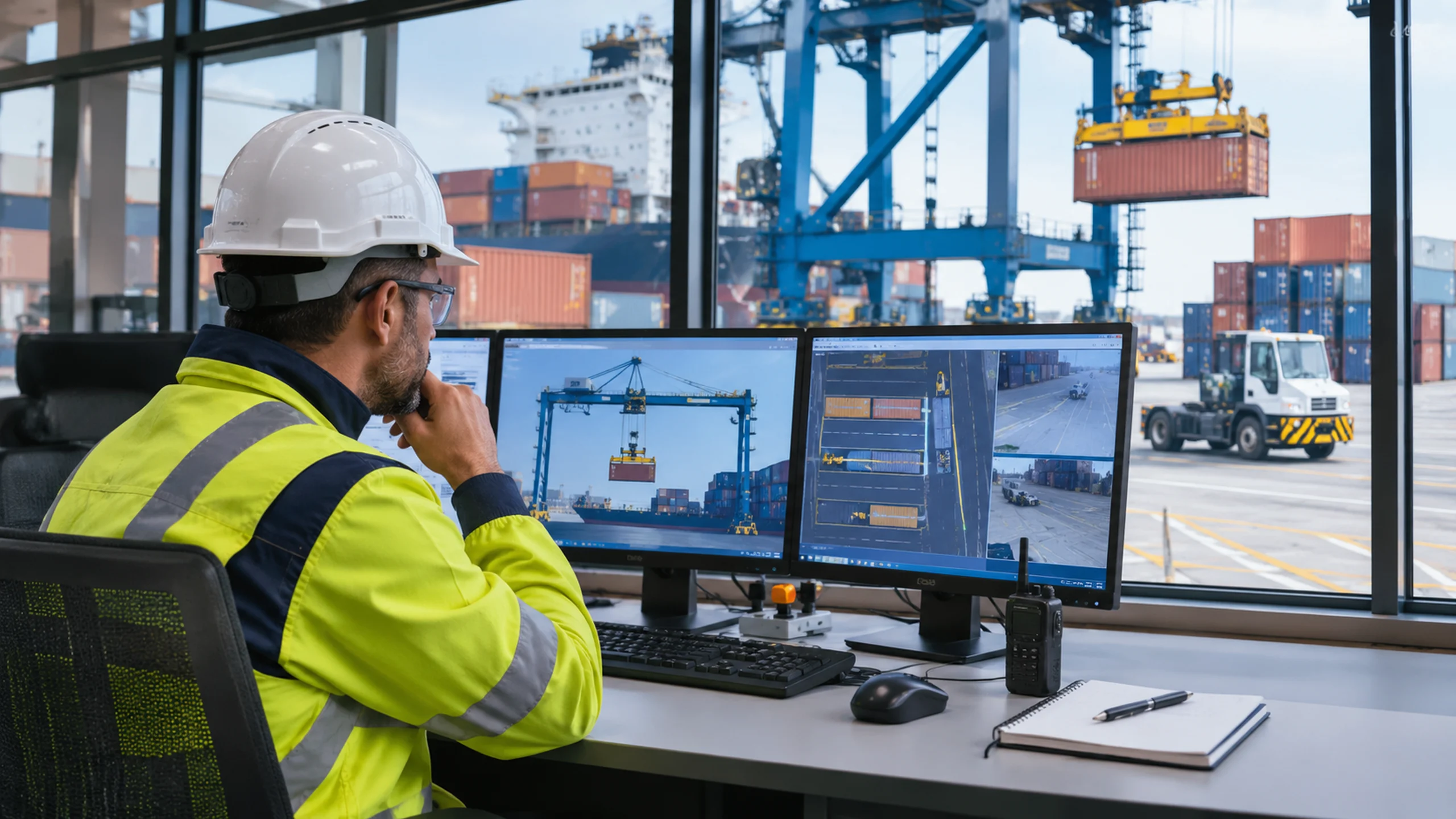
AI command authorization and crane operations at a port terminal

Verified AI Decisions and Physical Control Research for Port & Terminal Operations

Connecting artificial intelligence (AI)-supported decisions to port equipment requires more than generating a plausible recommendation. A terminal must establish which asset is involved, whether the operating information is current, who or what has authority to act, which equipment limits apply, and how the resulting physical state will be checked. This research adaptation examines methods for turning operational intent into constrained decisions and verifiable responses across port and terminal workflows.

Contact PortOps AI

The work is relevant to ship-to-shore cranes, rail-mounted and rubber-tired gantry cranes, terminal tractors, reach stackers, yard equipment, reefer container infrastructure, and selected building or energy subsystems. Each application requires its own equipment boundary, control interface, operating rules, and engineering review. A recommendation, work order, or workflow update is not equivalent to direct physical control.

The Control Problem in Port and Terminal Operations

Container terminals coordinate vessel operations, yard storage, gate activity, intermodal transfers, equipment availability, and safety procedures across a changing operating environment. Decisions may depend on container identity and location, crane or vehicle status, traffic conditions, work instructions, equipment health, berth plans, yard allocation, and time-sensitive operating data.

An AI system may propose a sequence, recommend a resource allocation, or request a bounded equipment intervention. The proposal can become unsafe or ineffective if it uses a stale crane state, an incorrect asset association, an expired approval, an unavailable terminal tractor, or an operating condition that changed after planning. A command may also be accepted by an interface without the intended physical movement taking place.

Research therefore needs to evaluate the complete path from observed state to decision, authorization, command dispatch, equipment response, and independent outcome confirmation. It must also examine what happens when a command is rejected, partially completed, delayed, duplicated, or interrupted.

Research Questions

  • How should an industrial AI agent express a proposed terminal action through a restricted command interface without gaining unrestricted access to equipment controls?

  • How can supervisory optimization account for crane operating envelopes, yard traffic rules, equipment availability, lift or load constraints, and terminal operating policies?

  • How should a system respond when sensor readings are stale, conflicting, incomplete, or inconsistent with the equipment state reported by a controller?

  • How can authorization remain bound to the specific asset, action, parameters, operating conditions, and approval period?

  • How should a planner handle multistep terminal tasks when one step is only partly completed, an actuator fails, permissions change, or a required resource becomes unavailable?

  • What independent evidence is sufficient to establish that a commanded movement or equipment intervention actually occurred?

Research Program Areas

Restricted AI Agents and Equipment Command Interfaces

This topic examines AI agents that can request narrowly defined actions through a controlled interface rather than interact directly with unrestricted programmable logic controller (PLC) functions or equipment networks. A terminal command gateway could validate the asset identity, requested operation, parameter range, user or service authority, approval token, command expiry, and current equipment preconditions before forwarding an eligible request.

Candidate methods include policy-based command filtering, typed action schemas, role-based permissions, allowlisted operations, precondition checks, approval binding, command deduplication, and immutable event records. Research should test whether an agent can be induced to request an action outside its permitted scope and whether the gateway rejects that request independently of the agent.

Potential terminal examples include a request to change a permitted operating mode, dispatch a task to an eligible yard vehicle, or initiate a predefined equipment sequence. The exact command set must be selected with the terminal's equipment and controls engineers. The research should not assume access to crane motion controls, vehicle steering, braking, or safety functions.

Adaptive Supervisory Control and Constrained Optimization

This topic examines supervisory decisions that adapt to changing terminal demand while respecting equipment and process limits. Potential inputs include vessel and berth plans, container moves, crane availability, yard occupancy, equipment status, traffic restrictions, reefer power demand, and relevant weather or environmental conditions. Candidate methods may include constrained optimization, model-predictive supervisory planning, rule-based policies, and hybrid decision systems.

The research boundary is supervisory coordination, not replacement of certified or engineered low-level control loops. For example, a planner may recommend a revised sequence or resource assignment when a crane becomes unavailable. Any resulting equipment command must pass through the terminal's approved control architecture and remain subject to independent protections and operator authority.

Building and energy subsystems may be considered where they are part of the terminal's operational boundary. Examples include terminal building HVAC, lighting schedules, shore-power coordination, and reefer power monitoring. A proposed intervention must respect equipment limits, electrical protections, environmental requirements, cargo-specific instructions, and the responsibilities of the relevant facility or equipment owner.

Multistep Planning, Checkpoints, and Reauthorization

Port workflows often involve several dependent steps and shared resources. A plan that was valid at the start of a task may no longer be valid after a container is delayed, a vehicle is reassigned, a crane enters a restricted state, or a permission is withdrawn. Research should examine plans that use fresh state observations, bounded retries, explicit checkpoints, and renewed authorization before continuing after a material change.

Candidate methods include hierarchical task planning, state-machine workflows, constrained planners, event-triggered replanning, and recovery policies. A planner should stop or request operator review when the next action depends on uncertain state, a failed precondition, an exceeded retry limit, or an authorization that is no longer valid.

Reefer and Environmental Interventions as Conditional Use Cases

Reefer container monitoring can provide a bounded research case where environmental readings, equipment status, alarm history, and cargo instructions inform an intervention workflow. The first research question is whether the system can identify a credible deviation and route it to the correct authorized party. Any change to a reefer setpoint or power state must remain under the applicable carrier, cargo, terminal, and equipment procedures; automated intervention should not be assumed.

Water, leak, and environmental process control should be included only where a specific terminal asset, process owner, response procedure, and control interface are identified. These are not universal terminal requirements and should not be added as generic capability claims.

Candidate System Architecture and Data Requirements

A research implementation should separate observation, decision, authorization, command, and outcome records. The architecture may include identification and sensing devices, edge gateways, operational data services, an AI decision service, an authorization service, a command gateway, equipment controllers, operator interfaces, and independent feedback sources. Actual interfaces and deployment locations must be selected after a site and equipment assessment.

  • Asset and context: asset_id, equipment_type, terminal_zone, task_id, operating_mode, and relevant work or move reference.

  • Observation: event_time, ingestion_time, measured_value, unit, source_device, quality_flag, freshness limit, and sensor or controller health.

  • Decision: decision_id, proposed_action, parameters, rationale or contributing factors, uncertainty indicator, model or policy version, and decision timestamp.

  • Authorization: approver or service identity, permitted action scope, approval time, expiry, applicable constraints, and revocation status.

  • Command: command_id, target asset, validated parameters, dispatch time, acknowledgement, timeout, retry count, and rejection reason.

  • Outcome: independently observed equipment state, position or process measurement, completion status, verification source, and verification time.

The data model should preserve the distinction between a controller acknowledgement and a verified physical result. A command response may show that a message was received or accepted; it does not by itself prove that a crane, vehicle, actuator, or subsystem reached the intended state. Time synchronization, event ordering, duplicate handling, missing data, and asset identity must be addressed.

Demonstration Design

A suitable initial demonstration is a bounded equipment rig or a simulator representing one selected terminal action workflow. The scenario should define the target asset, task objective, available resources, operating limits, command interface, authority model, independent protective functions, and evidence used to confirm completion. Numerical limits and safety settings must come from an engineering-approved specification, not from generic assumptions.

The demonstration should compare a fixed workflow or rule-based baseline with a candidate planner or AI-assisted method under matched conditions. It should include normal task execution and deliberately difficult cases that expose control and recovery behavior.

  • Stale or conflicting equipment observations presented before authorization or command dispatch.

  • A denied command because the requesting identity lacks permission or the approval has expired.

  • Partial task completion followed by an actuator or equipment failure.

  • A delayed, missing, duplicated, or reordered command acknowledgement.

  • A changed equipment state or resource assignment that invalidates the next planned step.

  • A communications interruption followed by a controlled timeout, safe hold, operator escalation, or approved recovery.

  • A human override or permission change while a multistep task is in progress.

Evaluation Measures

Evaluation should be defined before the demonstration. The measures below are candidate metrics; the selected workflow must specify each metric's unit, denominator, time window, event grouping rules, and acceptance criteria.

  • Verified completion rate: eligible attempted actions with independently confirmed completion divided by eligible attempted actions.

  • Unauthorized command rejection: unauthorized command attempts rejected by the command boundary, reported with the tested attack or misuse cases.

  • Constraint violation count: actions or plans that breach a defined equipment, process, traffic, or authorization constraint.

  • Sequencing error rate: multistep tasks with an invalid, skipped, duplicated, or out-of-order step divided by tasks evaluated.

  • Duplicate action rate: duplicate physical action attempts per eligible task or command set.

  • Stale-state rejection rate: commands blocked because the supporting observation exceeded its approved freshness limit.

  • Replanning time: elapsed time from a detected state change or failed step to a valid revised plan or operator escalation.

  • Operator intervention: intervention frequency, reason, response time, and whether the intervention restored a valid operating state.

  • Recovery performance: time and success rate for reaching an approved recovery state after failure or communications loss.

Results should include adverse cases and rejected commands, not only successful task completion. Report the baseline, candidate method, scenario coverage, number of runs or trials, variability, and known limitations. A small simulator test does not establish performance across different terminal layouts, crane types, traffic policies, equipment vendors, or operating conditions.

Human Authority, Safety, and Control Boundaries

Port terminal workers inspect yard equipment status on a tablet beneath container cranes.

The research must preserve the distinction between AI decision support and engineered equipment control. Human approval may be required for selected actions, and the level of autonomy must be justified by the task risk, equipment design, operating policy, and validation evidence. Emergency stops, safety interlocks, protective relays, and other independent safety functions must not depend on an AI agent to operate correctly.

  • Define who may request, approve, cancel, and override each action.

  • Bind approval to the asset, operation, parameters, and validity period.

  • Recheck equipment state and command preconditions immediately before dispatch.

  • Reject or hold commands when data is stale, permissions change, or required safeguards are unavailable.

  • Set bounded retries and explicit timeout, safe-hold, escalation, and recovery behavior.

  • Maintain traceable records of observations, decisions, approvals, commands, acknowledgements, overrides, and verified outcomes.

  • Validate cybersecurity boundaries and restrict the command gateway to approved operations and identities.

Current Research Status and Limitations

This page defines a proposed Port & Terminal Operations adaptation of the verified-decision and physical-control research topic. The supplied project brief identifies the research themes and a demonstration approach, but it does not provide PortOps AI-specific test results, a completed terminal equipment rig, a validated simulator, a customer pilot, or deployed control capability. No numerical performance claims are made here.

The current scope should therefore be treated as a research direction and evaluation specification. Before any results are published, the project needs a named equipment workflow, approved assumptions, a data and interface specification, a baseline, reproducible test records, calculated metrics, limitations, and technical review. Simulated behavior must be labeled as simulated. A successful software workflow or command-gateway test does not establish that a physical installation is safe, certified, or suitable for operational use.

Transfer to a live terminal would require site-specific engineering, equipment-owner approval, operational risk assessment, cybersecurity review, commissioning, and validation under the relevant procedures. Compatibility with a particular PLC, crane control system, terminal operating system, vehicle fleet, reefer controller, or building management system must be confirmed rather than assumed.

How This Research Connects to the PortOps AI Technology Architecture

The research connects the AI Decision Engine with the Physical AI Action Engine. The AI Decision Engine interprets identified assets, sensed conditions, and operational context to produce analysis or a proposed response. The Physical AI Action Engine provides the authorized path to people, workflows, equipment, controllers, and other physical systems, with feedback on the resulting state.

For this application, the essential distinction is between a decision proposal, an authorized command, an equipment acknowledgement, and an independently verified outcome. The related architecture and implementation pages describe the wider engine roles and the technology choices that would need to be assessed for a specific terminal.

Discuss a Port Terminal Control Research Use Case

A useful evaluation begins with one bounded workflow, such as a terminal equipment task request, a supervised resource adjustment, or an operator-approved response to a monitored subsystem condition. The initial discussion should identify the equipment owner, operational objective, current procedure, available observations, command boundary, approval roles, independent protections, and evidence needed to confirm the result.

Discuss a port terminal research use case
Scroll to Top