
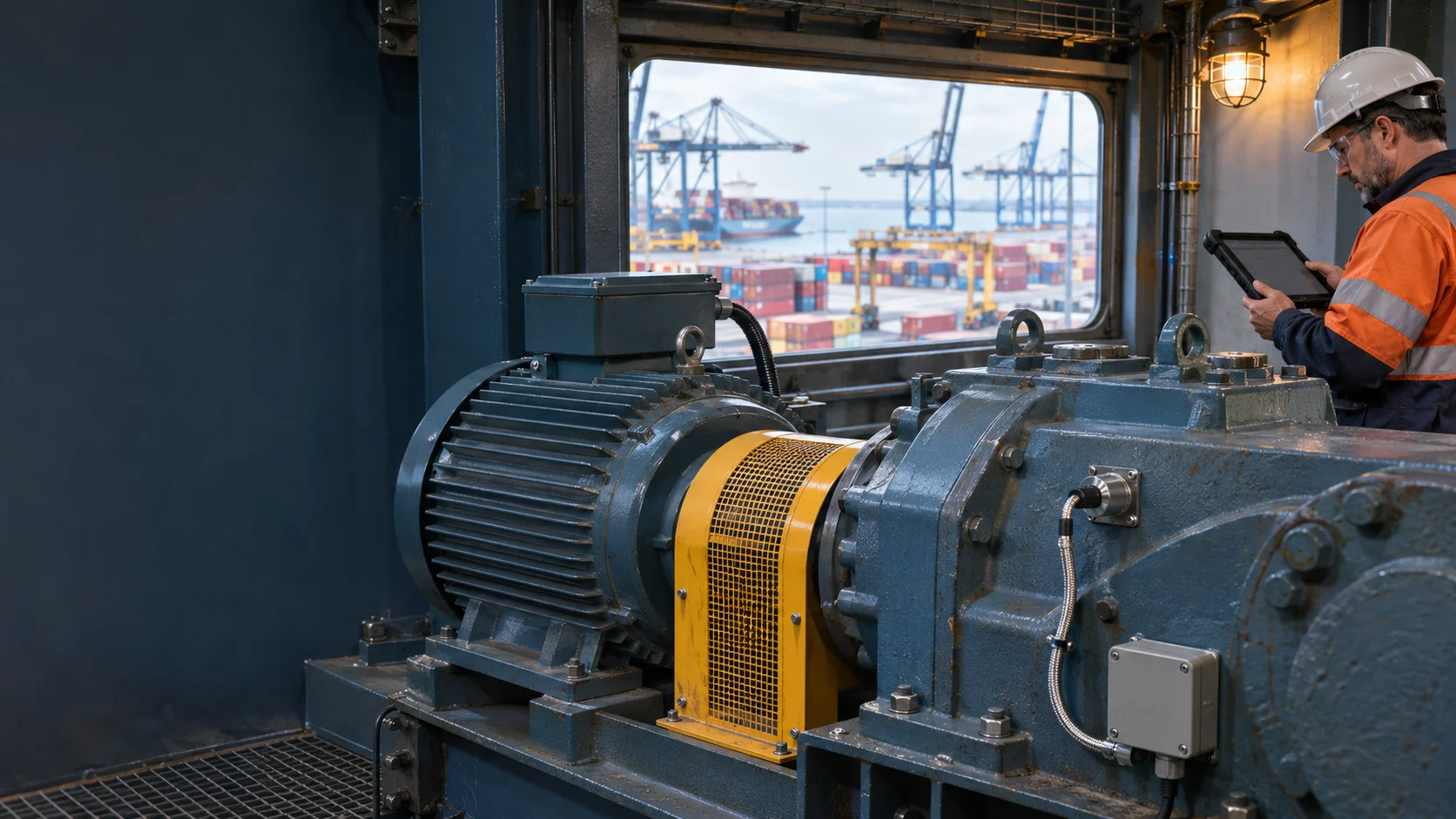
Condition Monitoring for Port & Terminal Operations
Port and terminal operations depend on equipment that must perform reliably across demanding duty cycles, changing loads, weather exposure, and continuous cargo-handling activity. Condition monitoring brings relevant measurements together so engineering and maintenance teams can assess the state of critical equipment, identify abnormal behavior, and decide what should be checked next.
Discuss a condition-monitoring application with PortOps AIFor container terminals, monitoring may apply to ship-to-shore (STS) cranes, rubber-tyred gantry (RTG) cranes, rail-mounted gantry (RMG) cranes, reach stackers, terminal tractors, conveyor systems, pumps, and other equipment selected through a site-specific assessment. The appropriate monitoring scope depends on the asset, its operating modes, accessible measurement points, and the consequences of an undetected condition.
PortOps AI focuses on Physical AI and Artificial Intelligence of Things (AIoT) for port and terminal operations. Its condition-monitoring approach connects physical measurements with asset identity, operating context, analysis, and a defined review process. Specific sensors, integrations, and decision functions must be selected and validated for each operating environment.
Monitor the Conditions That Matter to Terminal Equipment
A useful monitoring plan starts with the equipment question, not with a sensor catalog. A maintenance engineer may need to understand whether a crane hoist gearbox is showing a change in vibration, whether a motor is operating outside its expected temperature range, or whether a pump is experiencing an unusual pressure or flow condition.
Depending on the equipment and the monitoring objective, relevant measurements may include:
Vibration at motors, gearboxes, bearings, wheels, and rotating assemblies to identify changes in mechanical behavior.
Temperature at motors, bearings, electrical enclosures, hydraulic systems, and other locations where heat is a meaningful condition indicator.
Pressure and flow in hydraulic circuits, lubrication systems, pumps, and selected process lines.
Electrical measurements such as current, voltage, and power-related values for motors and drive systems.
Visual or thermal observations where an inspection task and suitable image-capture conditions have been defined.
Environmental measurements, such as ambient temperature or moisture exposure, when they help interpret equipment readings.
Sensor selection and placement require attention to measurement range, mounting method, sampling interval, calibration, power, communications, access for maintenance, and the physical environment. Salt exposure, vibration, dust, water ingress, electromagnetic interference, and restricted access can affect installation choices. A sensor specification should state its units, expected uncertainty, operating limits, and the conditions that could make its readings unreliable.
Put Every Reading in Its Operating Context
A measurement is difficult to interpret without knowing which asset produced it, when it was captured, and what the equipment was doing at the time. A vibration reading taken during a loaded hoist cycle may not be directly comparable with a reading taken while the crane is idle. Operating mode, load, speed, duty cycle, and recent maintenance can all affect the meaning of a signal.
A condition record should, where available, be associated with:
Asset identity and the relevant component or measurement point.
Event time, ingestion time, time zone, and sampling interval.
Operating mode and useful context such as load, speed, cycle, or equipment state.
Measurement value, unit, sensor identifier, and sensor-health information.
Quality flags for missing, delayed, duplicated, out-of-range, or suspect observations.
Calibration history, configuration changes, and maintenance or inspection events.
Raw signals and derived features should remain distinguishable. A raw vibration waveform contains information that may be lost when it is reduced to a single summary value. Derived features, such as an RMS value or frequency-domain indicator, can support practical analysis, but their usefulness depends on the sampling method, signal quality, and the fault or condition being investigated. Aggregated records cannot support conclusions that require information they no longer contain.
Separate Threshold Alerts from Anomaly Analysis
Threshold monitoring compares a measurement with a defined limit or operating band. It can be useful when an engineering limit or established operating range is available and the measurement is sufficiently reliable. Thresholds should account for relevant operating modes and should not be treated as universal values across different equipment models or duty conditions.
Anomaly detection looks for behavior that differs from an established baseline. Depending on the data and method, a baseline may account for load, speed, ambient conditions, equipment mode, and normal variation. A deviation is an indication for review, not proof of a specific fault or a confirmed diagnosis.
A monitoring design should explain how it handles:
Normal changes associated with load, speed, operating mode, startup, and shutdown.
False alerts caused by noise, transient events, poor mounting, or inappropriate thresholds.
Missing, delayed, duplicated, drifting, or outlier measurements.
Changes in sensor condition, calibration, configuration, or asset operating behavior.
Unfamiliar operating conditions where the analysis should abstain or request human review.
Where AI-supported analysis is considered, it should be compared with a credible rules-based baseline using representative data. The evaluation should distinguish anomaly detection from fault diagnosis, failure-risk estimation, and remaining useful life prediction. Those are different tasks and require different evidence. Condition monitoring alone does not establish a remaining-life estimate or prove that a failure will be prevented.
Route Alerts into a Defined Maintenance Workflow
An alert has operational value only when the right people can interpret it and determine what should happen next. Depending on the site workflow, a condition event may be routed to a reliability engineer, maintenance planner, electrical or mechanical technician, equipment supervisor, or terminal operations team.
A practical response path can include:
Capture the measurement with its asset identity, timestamp, operating mode, and quality status.
Check whether the observation is valid and whether the alert is relevant to the current operating condition.
Assign the finding for review by the responsible engineering or maintenance role.
Confirm the condition through an appropriate inspection, reference measurement, or equipment check.
Record the finding, maintenance decision, work performed, and any parts or downtime associated with the response.
Collect follow-up readings or inspection results to determine whether the condition changed.
A monitoring notification is not an equipment command. If a future implementation includes an approved control action, it must have a defined target, authority, operating limits, equipment interface, independent protective functions where required, and a method for checking the resulting physical state. A command acknowledgment alone does not prove that the intended physical outcome occurred.
Evaluate Monitoring Performance Before Expanding Coverage
A pilot should begin with a defined asset group, a specific condition question, and a baseline workflow. Select the measurement points and observation period based on the equipment and the operating conditions to be represented. Include routine operations as well as relevant load changes, shift patterns, startup and shutdown events, and known maintenance conditions where records are available.
Useful evaluation measures include:
Alert usefulness: the proportion of reviewed alerts that lead to a meaningful inspection, finding, or documented decision.
Fault or anomaly recall: the proportion of known and independently confirmed episodes detected by the monitoring method.
False-alert rate: false alerts per operating hour or another clearly stated exposure measure.
Detection delay: elapsed time between the defined onset of a detectable condition and the alert, where the data supports that calculation.
Missing-data handling: the frequency and duration of gaps, delayed messages, and invalid readings, and how the workflow responds.
Review workload: the time required to assess alerts, investigate findings, and close or escalate cases.
Follow-up verification: whether inspection and maintenance records, together with subsequent readings, confirm the reported outcome.
Calibration requirements, sensor maintenance, network availability, data retention, and integration effort should be included in the pilot assessment. Report results with the measurement definitions, time window, operating conditions, exclusions, and baseline method. Separate detection performance from any claimed operational or financial benefit. Avoid extrapolating a limited test to all terminal equipment or all operating conditions.
Build the Monitoring Scope Around Site Requirements
Port equipment differs by manufacturer, configuration, age, duty cycle, maintenance history, and operating environment. A monitoring design should therefore begin with an engineering and operational review rather than assuming that one sensor package or analytics method fits every asset.
The initial assessment should identify the equipment boundary, critical components, available instrumentation, existing control and maintenance records, network conditions, responsible users, and the operational consequences of missed or excessive alerts. It should also establish where processing will occur, how records will be protected, and which enterprise or equipment systems may need to exchange data. Compatibility with a particular device, protocol, or business system should be confirmed during technical discovery and integration testing.
PortOps AI can help frame the requirements for a Physical AI and AIoT condition-monitoring application, including the measurements, data context, decision workflow, integration dependencies, and evaluation plan. The actual implementation scope and capability status should be agreed and validated for the facility.
Discuss Condition Monitoring for Your Terminal
Start with the equipment and condition that matter most to your operation. Share the asset type, the current inspection or maintenance process, the measurements already available, and the operational question your team needs to answer.
Discuss a condition-monitoring application with PortOps AI