
Condition Monitoring for Port and Terminal Equipment
Container terminals depend on the availability of ship-to-shore (STS) cranes, rubber-tyred gantry (RTG) cranes, rail-mounted gantry cranes, reach stackers, terminal tractors, and supporting mechanical and electrical systems. When a critical drive, bearing, hydraulic circuit, or power component begins to behave differently, maintenance teams need enough context to determine whether the change requires inspection, planned work, or continued observation.
Condition monitoring brings equipment measurements together with asset identity and operating context. For port operations, that means interpreting a reading in relation to the machine, component, duty cycle, movement, load condition, and operating environment. A vibration increase during a loaded hoist cycle may need a different review from the same reading while equipment is idle or undergoing maintenance.
PortOps AI applies Physical AI and Artificial Intelligence of Things (AIoT) concepts to connect sensing, data interpretation, and maintenance workflows. The appropriate design depends on the equipment selected, available signals, site conditions, existing systems, and the actions authorized by the terminal. The application described here is an approach for evaluation, not a claim that a particular sensor package, connector, or deployed monitoring service is already available.
Contact PortOps AIWhich Equipment and Components Can Be Monitored?
A practical monitoring scope starts with a defined equipment class and a specific maintenance question. For example, a terminal may begin with the hoist and travel drive systems on RTG cranes, then assess whether the same approach is suitable for STS crane machinery or reach stacker powertrain and hydraulic systems.
- RTG and rail-mounted gantry cranes: hoist motors, gearboxes, bearings, trolley and gantry travel drives, wheel assemblies, and selected hydraulic or electrical systems.
- Ship-to-shore cranes: hoist and trolley machinery, drive motors, gear reducers, bearings, and selected auxiliary systems, subject to equipment design and access.
- Reach stackers and other mobile handling equipment: engine or electric-drive condition, transmission, wheel-end components, hydraulic pumps, hydraulic pressure behavior, and cooling systems.
- Terminal support equipment: selected pumps, compressors, generators, and other fixed assets whose condition can affect equipment availability or terminal services.
The monitoring boundary should identify the component, its failure or degradation modes, the measurements that can reveal a meaningful change, and the maintenance decision that follows. Structural inspections, statutory examinations, original equipment manufacturer (OEM) maintenance requirements, brake tests, and independent safety protections remain necessary. Sensor readings do not replace those controls or certify that equipment is safe to operate.
Measurement Plan for Crane and Yard Equipment
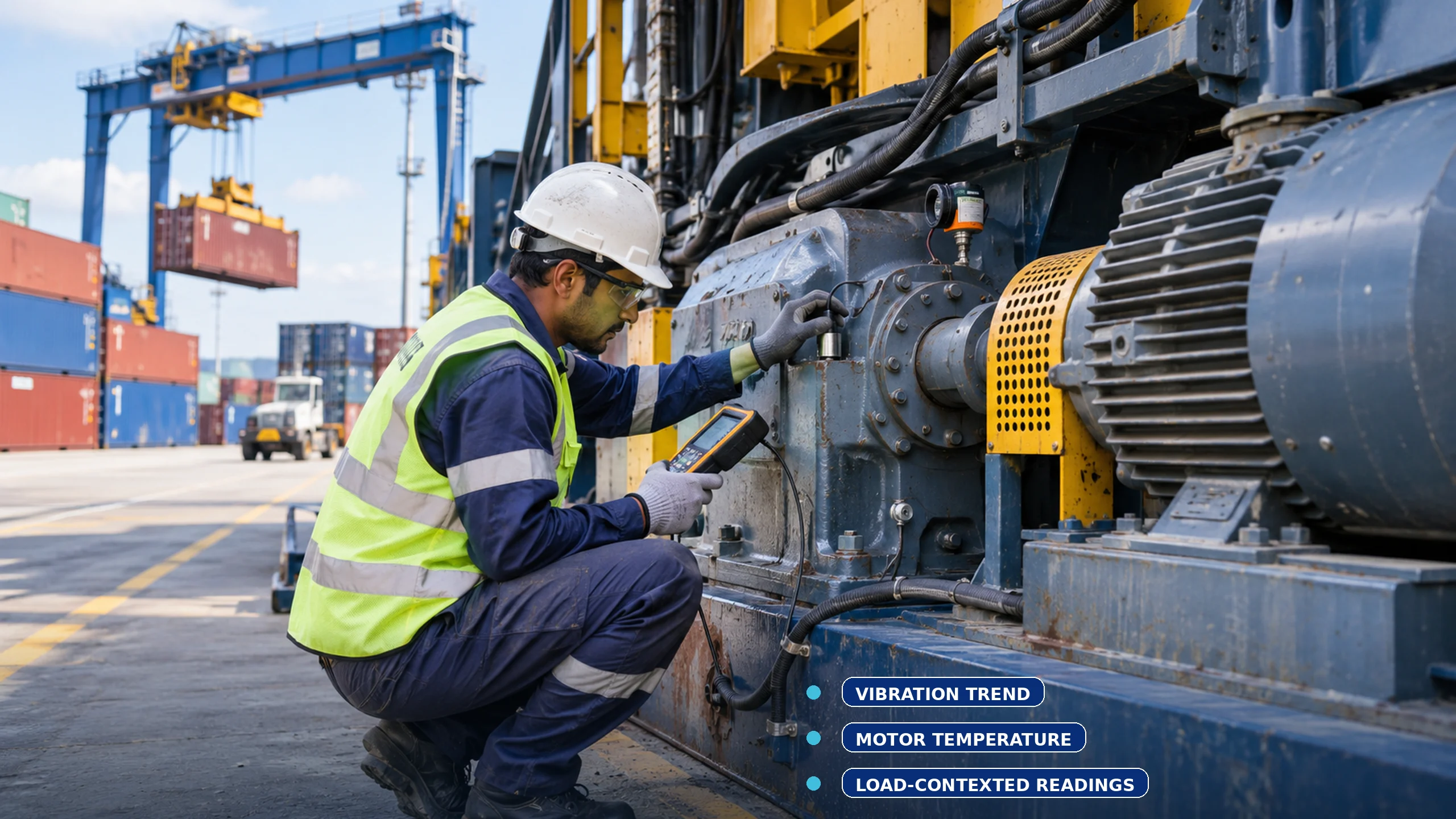
Sensor selection and placement should follow the physical condition being assessed. Measurements may include vibration at motor and gearbox bearing locations, surface or bearing temperature, motor current and power, hydraulic pressure, oil condition, acoustic signals, and visual or thermal inspection data. Not every variable is appropriate for every asset. Measurement range, mounting method, sampling rate, environmental protection, calibration, power, and access for maintenance must be reviewed for the selected machine.
For rotating machinery, vibration measurements can help identify changes in bearing, gear, alignment, or balance behavior when the sensor location and acquisition method preserve the signal needed for analysis. Temperature and motor-current trends can add context, while hydraulic pressure and oil measurements may be more relevant to hydraulic equipment. Visual or thermal inspections can supplement instrument readings where access, lighting, surface condition, and safe inspection procedures permit.
Raw signals should be distinguished from derived features. A raw vibration waveform, for example, is not the same as a calculated root-mean-square value, frequency-band feature, or anomaly score. Aggregated readings may be suitable for trend review but may not contain enough detail to diagnose a specific fault. The data specification should state what is captured, what is calculated, and what information is retained for later investigation.
Operating Context Makes Measurements Useful
A measurement should be associated with the correct asset and component, timestamp, unit, sensor identity, quality status, and operating mode. For container-handling equipment, useful context may include hoist, trolley, gantry travel, idle, startup, shutdown, maintenance, and fault states. Where the terminal can lawfully and technically provide it, cycle counts, load information, equipment utilization, and relevant environmental conditions can help explain normal variation.
Time alignment matters. Sensor events, programmable logic controller (PLC) states, operator records, and maintenance history may use different clocks or sampling intervals. The integration design should define event time, ingestion time, time zone, missing-data handling, duplicate handling, and how late-arriving observations are reconciled. A stale or incomplete observation should be flagged rather than treated as a current equipment state.
Sensor health is part of the condition record. Loose mounting, drift, damaged cables, power interruptions, communication loss, contamination, and incorrect asset association can produce misleading patterns. Quality flags and device-health records help maintenance teams distinguish a possible equipment issue from an unreliable measurement.
From Baseline Analysis to Maintenance Review
Condition analysis can begin with engineering limits and operating baselines, then add anomaly detection where representative data supports it. A fixed threshold is useful when a measurement has a well-understood limit under defined conditions. A learned anomaly method may help identify combinations or trends that are difficult to express as a single threshold, but it must be evaluated against normal variation across equipment, duty cycles, and operating modes.
An alert should explain which asset and component are affected, what changed, which observations support the finding, how recent and complete the data is, and what level of review is recommended. The system should distinguish a detected deviation from a confirmed fault. When data is stale, incomplete, outside the evaluated operating conditions, or too uncertain to interpret, the workflow should flag the limitation and route the case for human review.
A maintenance supervisor or reliability engineer can use the alert to decide whether to continue observation, request an inspection, schedule diagnostic testing, or create a maintenance work order. Prioritization should consider equipment criticality, operational impact, repeat observations, inspection findings, and available maintenance resources. The application should not automatically issue a command to operate, stop, or alter equipment unless a separate, engineered, authorized control design has been reviewed and validated.
Integrating Condition Findings with Terminal Workflows
Condition records become more useful when they can be connected to the terminal's equipment register, maintenance history, and operational records. Depending on the site's architecture and approved interfaces, relevant systems may include a computerized maintenance management system (CMMS), supervisory control and data acquisition (SCADA) environment, PLC data source, or terminal operating system (TOS). These are potential integration points, not assumed existing PortOps AI connectors.
A practical data flow links the equipment identifier and component to measurements, operating context, analysis results, inspection findings, and maintenance records. A CMMS work order may record the assigned task, technician observations, replaced parts, repair completion, and return-to-service approval. After maintenance, follow-up measurements can help determine whether the observed condition changed. A work-order closure or controller acknowledgment alone does not prove that the physical issue has been resolved.
Integration planning should document data ownership, interface availability, identifiers, event timing, access permissions, retention, network dependencies, and behavior during outages. Edge processing may be considered where local response time, connectivity, or data volume makes it appropriate. Deployment location and system compatibility must be confirmed for each terminal.
From Condition Alert to Verified Maintenance
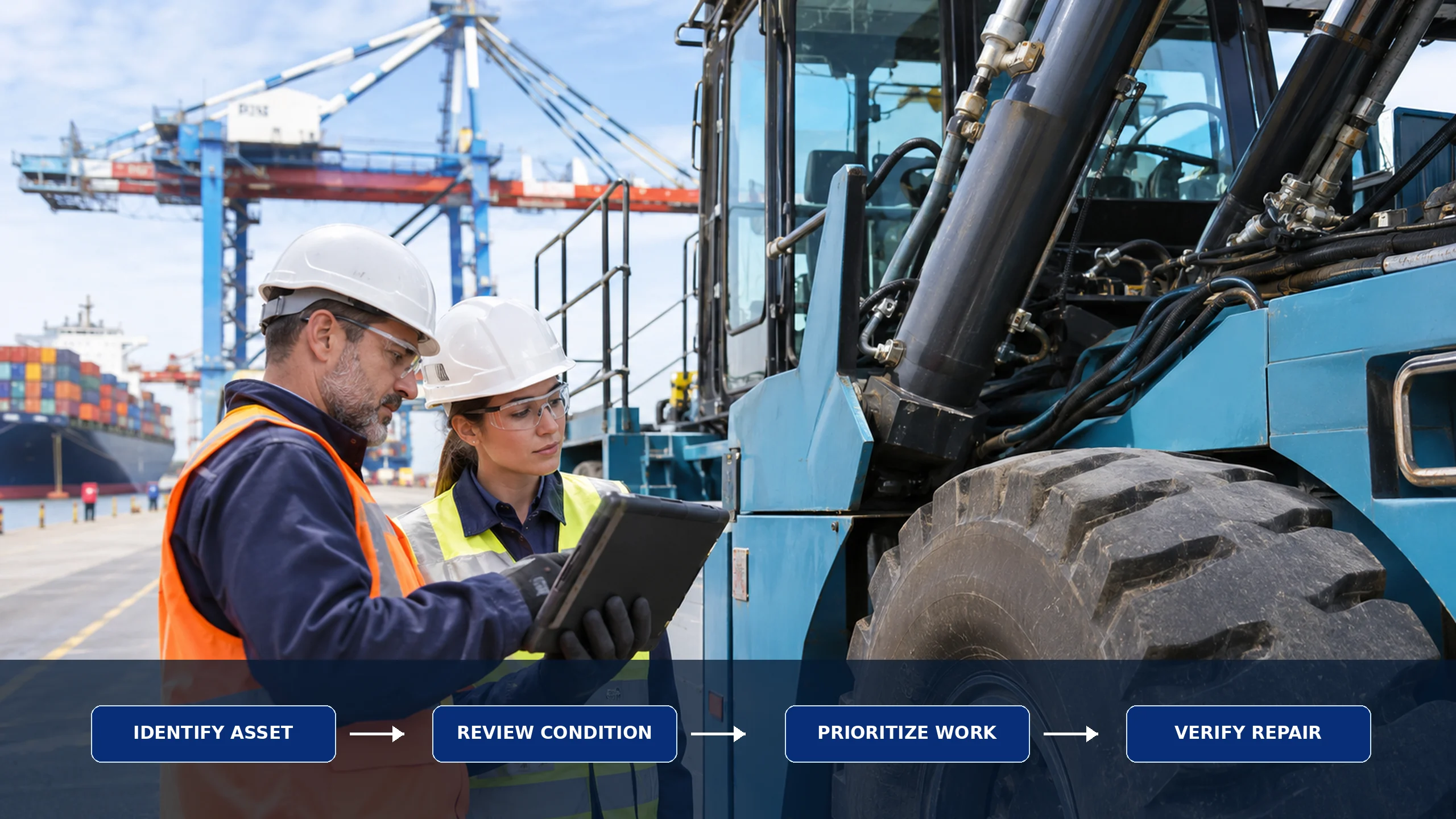
The operating workflow should connect an observation to a reviewable maintenance outcome. First, associate each measurement with the correct crane or mobile equipment asset. Next, check data quality and compare the reading with the appropriate baseline for its operating mode. A responsible engineer reviews the alert, decides whether inspection or maintenance is warranted, and records the finding in the relevant maintenance workflow. Following the work, the team checks the equipment condition again and records whether the expected change was observed.
How to Evaluate a Condition Monitoring Application
A pilot should test whether the measurements are technically reliable and whether the resulting alerts improve a defined maintenance workflow. The evaluation plan should be agreed before results are reviewed and should include normal operating cycles, known maintenance conditions where available, expected operating variation, and deliberately challenging data-quality cases.
- Measurement coverage and quality: percentage of expected readings received, sensor uptime, calibration status, missing intervals, and correct asset association.
- Detection performance: fault or abnormal-condition recall, false-alert rate per operating hour, missed events, and detection delay, with each metric defined against reviewed inspection or maintenance evidence.
- Operational usefulness: percentage of alerts judged actionable by maintenance reviewers, time to review and disposition, inspection workload, and work-order follow-through.
- Verification: whether post-inspection or post-maintenance measurements support the recorded finding and whether the equipment returns to its approved operating state.
- Robustness: behavior during sensor drift, communication outages, delayed messages, changing load or duty cycles, startup and shutdown, and equipment-specific variation.
Detection results should be reported separately from operational or financial effects. Earlier detection does not automatically establish avoided downtime or cost savings. Those outcomes require evidence that an intervention was feasible, authorized, effective, and completed in time, together with the resources and consequences represented in the evaluation.
Implementation Considerations and Safety Boundaries
Before deployment, the terminal should confirm equipment access, sensor mounting constraints, hazardous-area or environmental requirements where applicable, power and network availability, maintenance windows, cybersecurity controls, and responsibilities for device servicing. The design should account for vibration and shock, dust, moisture, salt exposure, temperature variation, electromagnetic interference, and the practical limits of installing or replacing sensors on working equipment.
Condition monitoring is a decision-support function. It does not replace operator pre-use checks, scheduled inspections, OEM instructions, statutory examinations, safety interlocks, or the judgment of qualified maintenance personnel. Any proposed physical control or automatic shutdown function requires a separate risk assessment, engineered control design, authorization model, and validation under the applicable site and equipment requirements.
Discuss an Equipment Condition Monitoring Application
PortOps AI can help define an evaluation scope around a selected crane, reach stacker, or terminal support asset. Start with the component of concern, the available measurements and maintenance records, the operating modes that affect readings, and the decision the maintenance team needs to make.
Discuss equipment condition monitoring